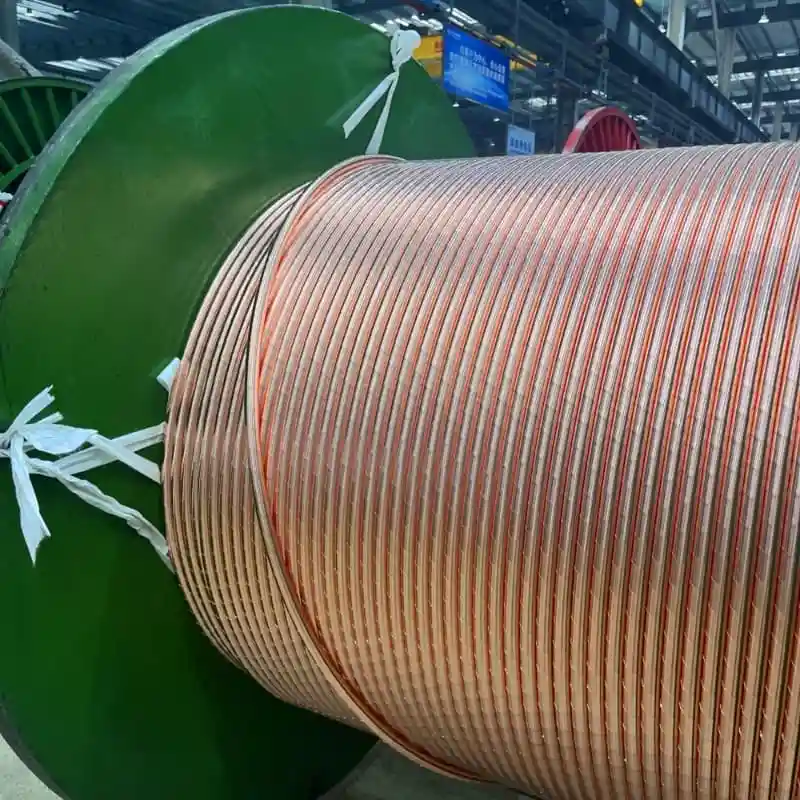


YJV Cable Explained: XLPE Insulated Power Cable Selection Guide for International Buyers
Release time: 2026-10-26
What Does YJV Mean? Breaking Down the Designation
YJV is the Chinese national standard (GB/T 12706) designation for a copper conductor, XLPE insulated, PVC sheathed power cable. Understanding the letter code tells you everything about its construction:
| Letter | Meaning | English |
|---|---|---|
| Y | Cross-linked polyethylene insulation | XLPE insulation |
| V | Polyvinyl chloride sheath | PVC outer sheath |
Wait — that’s only two letters doing three jobs. The code is actually read as YJ + V:
- YJ = XLPE insulation (cross-linked polyethylene)
- V = PVC sheath (polyvinyl chloride)
So YJV = XLPE insulated + PVC sheathed power cable. The conductor is always copper unless marked otherwise (YJLV = aluminium conductor).
The Full Family Tree
| Designation | Conductor | Insulation | Sheath | Typical Use |
|---|---|---|---|---|
| YJV | Copper | XLPE | PVC | General power distribution |
| YJLV | Aluminium | XLPE | PVC | Overhead/long runs, cost-driven |
| YJV22 | Copper | XLPE | PVC + steel tape armour | Direct burial |
| YJV23 | Copper | XLPE | PVC + fine wire armour | Burial, rodent-prone areas |
| YJV32 | Copper | XLPE | PVC + steel wire armour | Vertical shafts, water crossings |
| YJY | Copper | XLPE | PE sheath | Moisture/corrosion environments |
| YJV62 | Copper | XLPE | LSZH sheath + armour | Tunnels, public buildings |
Construction: Layer by Layer
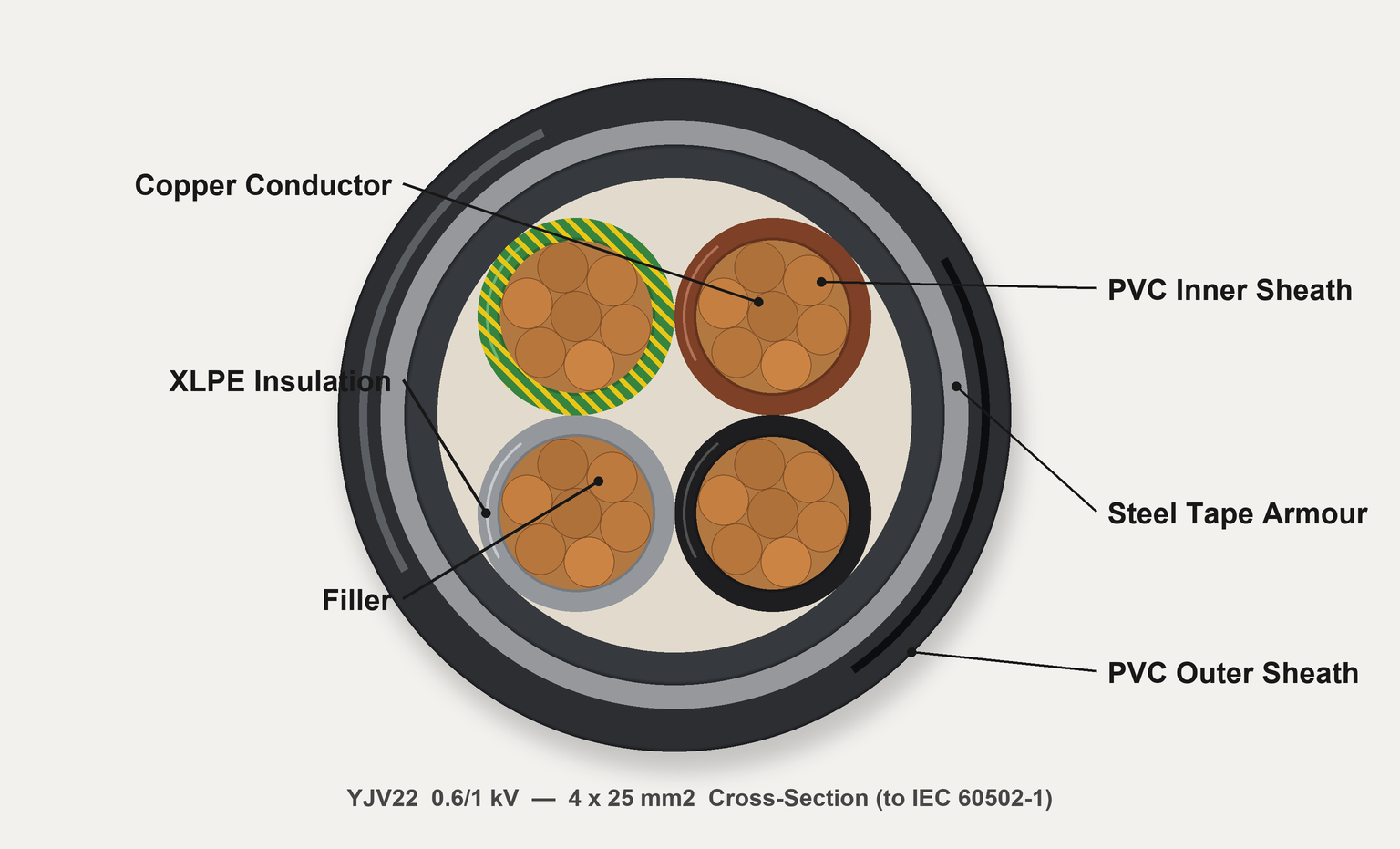
A typical 4-core YJV 0.6/1 kV cable from the inside out:
- Conductor — annealed plain copper, Class 2 (stranded) per IEC 60228, 1.5–630 mm²
- XLPE insulation — cross-linked polyethylene, nominal 0.7–2.0 mm depending on size
- Filler & binder tape — keeps the laid-up core circular
- Inner sheath (extruded or taped) — PVC or PE
- Armour (for YJV22/32 variants) — galvanised steel tape or steel wire
- Outer sheath — black PVC, ST1/ST2 per IEC 60502-1
Why XLPE Beats PVC Insulation
| Property | PVC (VV cable) | XLPE (YJV cable) |
|---|---|---|
| Max conductor temperature | 70 °C | 90 °C |
| Short-circuit temp (5 s) | 160 °C | 250 °C |
| Current rating (same size) | baseline | +20–30% |
| Insulation resistance | good | 100–1,000× better |
| Dielectric loss at MV | higher | lower |
| Water tree resistance | moderate | good (with dry curing) |
The 90 °C continuous rating is the money line: for the same conductor cross-section, YJV carries 20–30% more current than a PVC-insulated VV cable — or you downsize one step and save copper.
Voltage Ratings and Standards Mapping
YJV per GB/T 12706 covers 0.6/1 kV (LV) up to 26/35 kV (MV). For export buyers, here’s how YJV maps to international standards:
| Chinese YJV | IEC | BS | Other equivalents |
|---|---|---|---|
| YJV 0.6/1 kV | IEC 60502-1 | BS 5467 (SWA/PVC) | DIN VDE 0276 NYY/N2XY |
| YJV 3.6/6–26/35 kV | IEC 60502-2 | BS 6622 / BS 7835 | ANSI/ICEA S-94-649 |
Key points for international buyers:
- IEC 60502-1/2 is the harmonised baseline — YJV produced to it is directly comparable with N2XY (Germany) or BS 5467 types (UK)
- Conductor to IEC 60228 Class 2 (stranded) is the export default; Class 5/6 flexible on request
- MV versions are screened (semicon + copper tape) with 90 °C XLPE — equivalent to BS 6622 construction
- Fire performance variants: WDZ-YJV (low smoke zero halogen, IEC 60332-3 / 60754 / 61034) for tunnels and high-rises
Real Technical Parameters (0.6/1 kV, 4-Core, Copper/XLPE/PVC)
| Conductor (mm²) | Insulation (mm) | Overall Ø (mm) | Current Capacity in Air (A) | In Ground (A) | DC Resistance @20 °C (Ω/km) |
|---|---|---|---|---|---|
| 4 × 16 | 0.7 | 19.5 | 80 | 84 | 1.15 |
| 4 × 25 | 0.9 | 23.0 | 105 | 110 | 0.727 |
| 4 × 35 | 0.9 | 25.0 | 130 | 133 | 0.524 |
| 4 × 50 | 1.0 | 28.0 | 160 | 161 | 0.387 |
| 4 × 70 | 1.1 | 32.0 | 205 | 200 | 0.268 |
| 4 × 95 | 1.1 | 36.5 | 250 | 240 | 0.193 |
| 4 × 120 | 1.2 | 40.0 | 290 | 272 | 0.153 |
| 4 × 150 | 1.2 | 44.0 | 330 | 304 | 0.124 |
| 4 × 185 | 1.3 | 48.5 | 380 | 344 | 0.0991 |
| 4 × 240 | 1.4 | 54.5 | 450 | 396 | 0.0754 |
| 4 × 300 | 1.4 | 60.0 | 515 | 446 | 0.0601 |
Values are typical of IEC 60502-1 constructions; exact figures vary by manufacturer — always confirm against the type-test report.
Where YJV Is Used
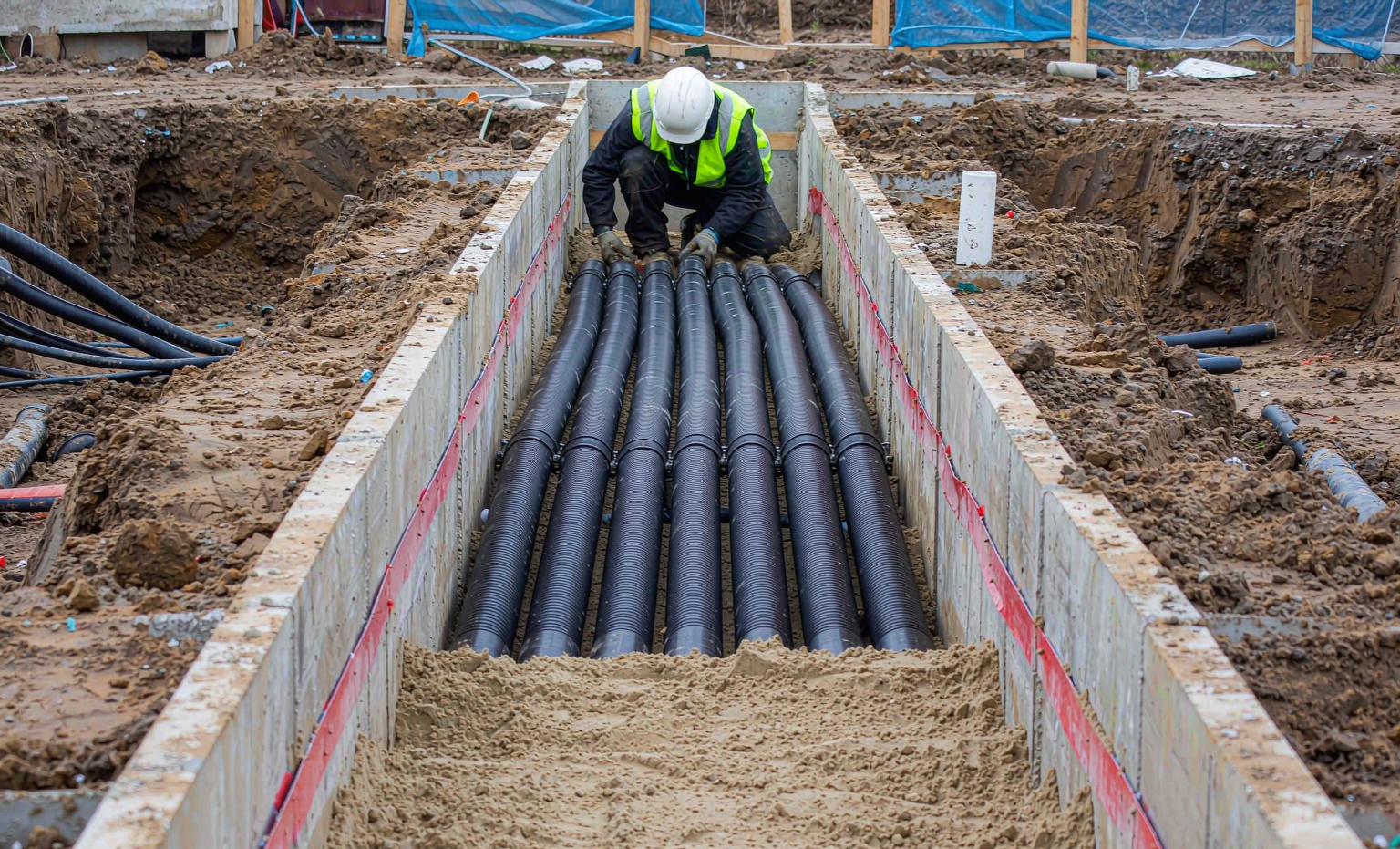
Building distribution (0.6/1 kV) — main feeders from transformer to main switchboard, riser cables in high-rises, sub-main distribution. This is the volume workhorse.
Infrastructure — airports, metros, tunnels (LSZH variant), water treatment plants, data centres.
Renewables — MV collection systems for solar farms (3.8/6.6 kV and above with appropriate screening) and wind farms.
Industrial — plant primary distribution, mining surface installations (with armour), pump stations.
When NOT to use YJV:
- Frequent bending/mobile applications → use YC rubber cable instead
- Control circuits → KVV / control cable
- Household fixed wiring at 450/750 V → BV/BVR
- Direct burial without armour → always add steel tape (YJV22)
Five-Step Selection Method
- Voltage class — 0.6/1 kV for building/industrial LV; 6/10, 8.7/15, 12/20, 26/35 kV for MV networks. Never underspecify Uo/U.
- Conductor material — copper for everything indoor/compact; aluminium (YJLV) for long overhead or budget-sensitive feeder runs where bending radius permits.
- Insulation level — XLPE is standard; if the environment is a tunnel, metro or occupied building, upgrade sheath to LSZH (WDZ-YJV / YJV62).
- Armour decision — direct burial → YJV22 (steel tape); vertical drop or water crossing → YJV32 (steel wire); in conduit indoors → unarmoured YJV.
- Size by derating — use the ambient/installation correction factors (IEC 60364-5-52), then verify voltage drop ≤ 4–5% for feeders and check short-circuit thermal withstand (250 °C XLPE limit).
Common Buyer Mistakes
- Ordering VV “because it’s cheaper” — at the same ampacity, VV needs 1–2 sizes larger conductor; YJV usually wins on total system cost.
- Mixing up 0.6/1 kV and 1.8/3 kV — the latter is an MV-screened design, not a “heavier LV cable”; using it as LV wastes money.
- Direct burial of unarmoured YJV — PVC sheath alone will not survive ground movement or rodents; specify YJV22 minimum.
- Ignoring the screen on MV cables — removing the copper screen to save cost creates uncontrolled electric fields and failures at joints.
- Assuming LSZH by default — standard YJV PVC sheath burns with dense smoke; tunnels and public buildings need the WDZ- prefix explicitly.
FAQ
Q1: Is YJV equivalent to BS 5467 SWA cable? Close but not identical. BS 5467 mandates steel wire armour for multicore; YJV is unarmoured by default. For a direct equivalent order YJV22 (steel tape) or YJV32 (steel wire) built to IEC 60502-1 — construction and performance align.
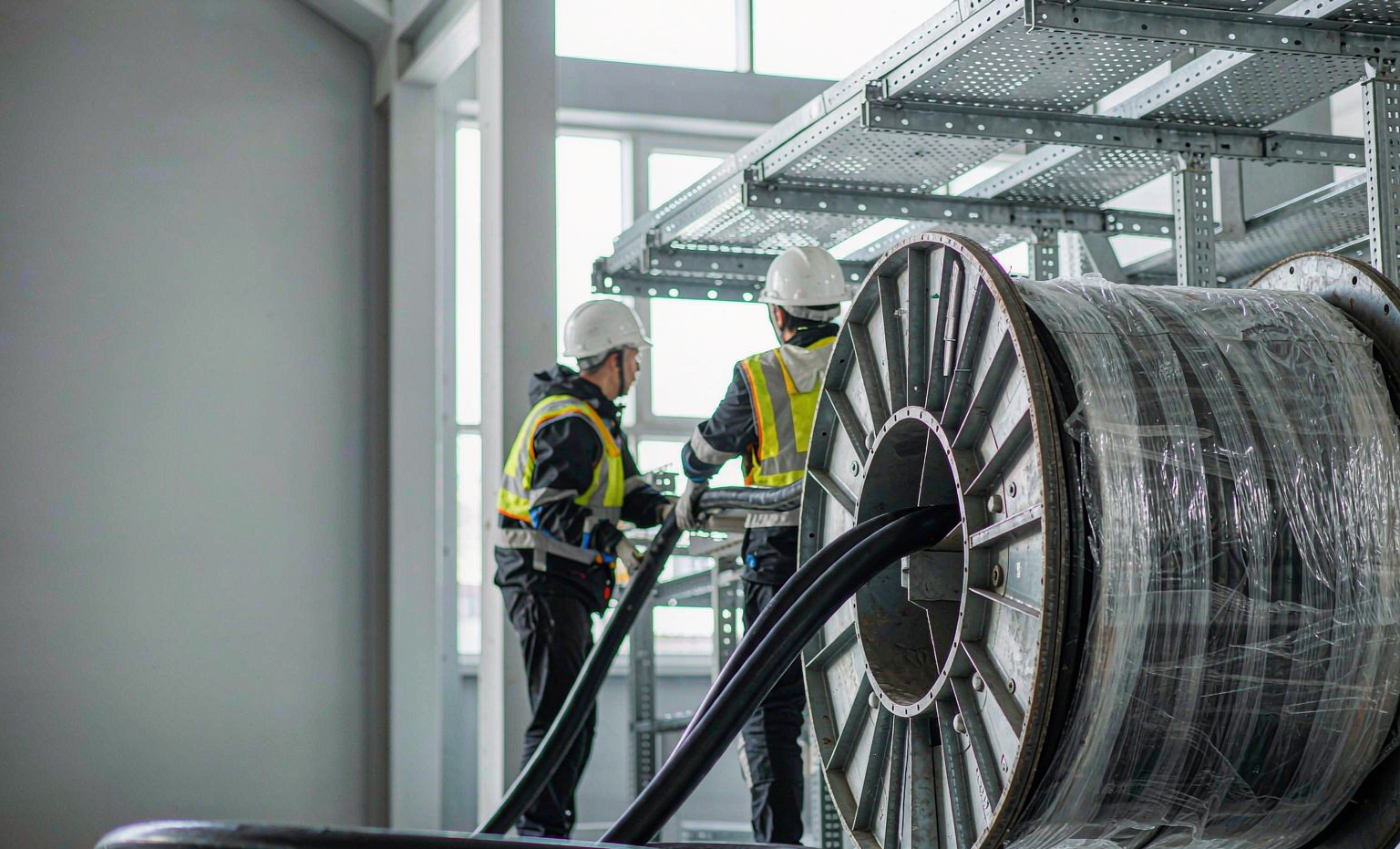
Q2: Can YJV be run in cable trays and ladders? Yes — unarmoured YJV is the standard tray cable. Add mechanical protection (conduit/trunking) only where impact risk exists.
Q3: What’s the maximum operating temperature? 90 °C continuous conductor, 250 °C short-circuit (5 s max). Keep emergency loading within the 130 °C / 100 h guideline unless the manufacturer states otherwise.
Q4: Does YJV support solar farm MV collection? Yes — YJV 3.8/6.6 kV to 12/20 kV with copper screen is widely used for PV collector circuits. For the DC side strings you need PV1-F / EN 50618 solar cable instead.
Q5: What is WDZ-YJV? The low-smoke zero-halogen variant: LSZH sheath/insulation meeting IEC 60332-3 (flame spread), 60754 (halogen acid gas) and 61034 (smoke density). Specified for tunnels, metros, high-rises and enclosed public spaces.
Q6: What is the minimum bending radius? Unarmoured: 12× OD. Armoured (YJV22/32): 15× OD. Single-core MV with screen: 15× OD. Plan pullpoints accordingly.
Why Source YJV from XiJiangYue Cable
- Conductor to IEC 60228, construction to IEC 60502-1/-2, type-tested with full routine test reports per drum
- Full range 1.5–630 mm² (LV) and up to 26/35 kV (MV), copper and aluminium
- Armour, LSZH and PE-sheath variants on the same production platform — one supplier, one MOQ
- Drum marking, third-party inspection (SGS/BV/TÜV on request) and export-grade seaworthy packing
Need a quotation with a guaranteed delivery date? Send your schedule (core count × mm², voltage, armour, length) to our engineering team — we respond within 24 hours.