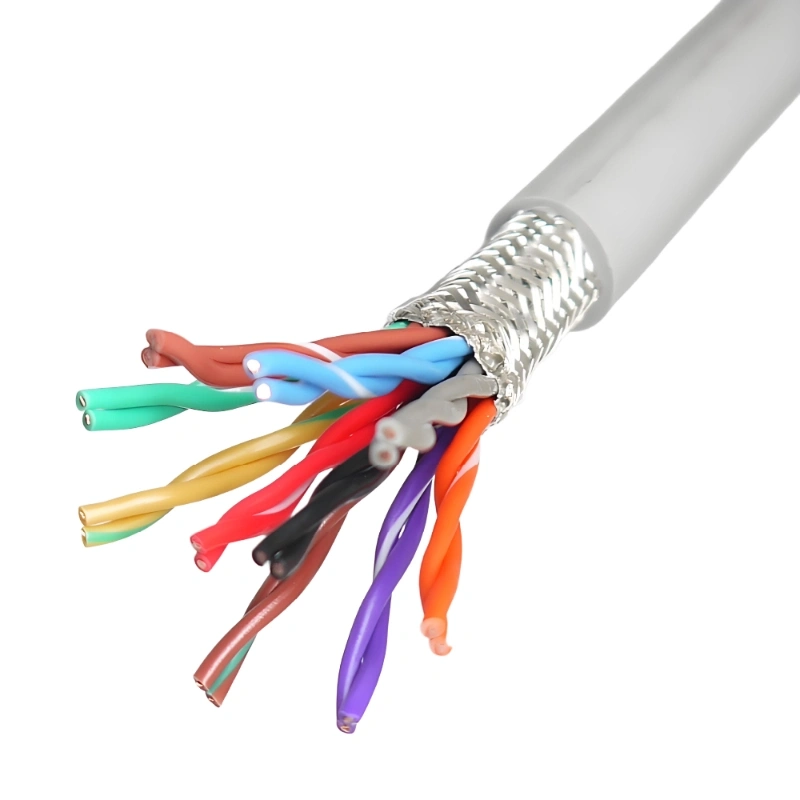


What is low-voltage cable?
Release time: 2025-12-02
When planning a new construction project, upgrading factory equipment, or deploying security systems, “cable” is often the last component considered—yet it serves as the critical foundation determining the entire system’s success or failure.
Technically speaking, low-voltage cables typically refer to those used to transmit electrical power at 1000 volts (AC) or 1500 volts (DC) and below. But “low voltage” does not equate to “low requirements.” On the contrary, precisely because they carry the pulse of information and control commands, their quality directly determines the system’s safety, stability, and future scalability.

II. In-Depth Analysis: Why Are They the Optimal Solutions for Different Scenarios?
- V2XY (YJV) – Copper-Core Cross-Linked Cable: The Cornerstone of Reliability
Core Structure: High-purity copper conductor + XLPE insulation + PVC sheath.
Performance Advantages:
Superior Conductivity: Minimal power transmission loss and high efficiency.
Heat Resistance Champion: Long-term operating temperature up to 90°C, short-circuit withstand temperature 250°C, strong overload capacity, and outstanding safety.
Extended Lifespan: XLPE material offers superior aging resistance, resulting in low system lifecycle costs.
Typical Applications: Building main distribution trunk lines, critical industrial loads, data centers, commercial complexes, and all fixed installations demanding extremely high power supply reliability.
- NA2XY (YJLV) – Aluminum Conductor XLPE Cable: Strategic Cost-Effective Solution
Core Structure: High-conductivity aluminum conductor + XLPE insulation + PVC sheath.
Performance Advantages:
Significantly lighter: Approximately 60% lighter than copper cables of equivalent specifications, substantially reducing installation labor intensity and cable tray load-bearing requirements.
Outstanding cost advantage: Material costs are significantly lower than copper cables while meeting current-carrying capacity requirements, making it particularly suitable for budget-sensitive or large-cross-section projects.
Retains XLPE Advantages: Maintains 90°C temperature rating and excellent electrical performance.
Key Installation Notes: Aluminum conductor connections must use dedicated transition terminals with secure tightening to prevent contact oxidation and creepage heating.
Typical Applications: Long-distance power trunk lines, substation feeders, internal collection circuits in solar/wind farms, and large facilities sensitive to weight.
- N2XRY (YJV32) – Copper-Core Steel-Wire Armored Cable: Guardian for Harsh Environments
Core Structure: Copper conductor + XLPE insulation + galvanized fine steel wire armor layer + PVC outer sheath.
Performance Advantages:
Superior Mechanical Protection: Steel wire armor delivers exceptional tensile strength and compression resistance, effectively shielding against mechanical damage and rodent bites.
Engineered for Vertical & Traction Applications: The preferred choice for cable shafts, high-drop installations, bridges, mines, and other scenarios requiring resistance to self-weight or external traction forces.
Direct Burial Capability: Can be laid directly in soil without additional protective conduits.
Typical Applications: High-rise building shafts, rail transit, hydroelectric power stations, mining, outdoor direct burial, and any complex environments with potential mechanical risks.
- NYBY (VV22) – Aluminum-Core Steel Tape Armored Cable: Classic Cost-Effective Protection
Core Structure: Aluminum conductor + PVC insulation + Double-layer galvanized steel tape armor + PVC outer sheath.
Performance Advantages:
Cost-effective protection: Steel tape armor delivers excellent crush resistance and external damage protection at a significantly lower cost than steel wire armor.
Basic Performance Suitable for: Applications with stable loads and no special high-temperature requirements.
Key Limitations: PVC insulation has a long-term operating temperature of 70°C, with significantly lower heat resistance and overload capacity than XLPE-insulated cables.
Typical Applications: Cost-controlled indoor conduit installations, tunnels, direct burial, and general industrial environments with stable loads.
III. Golden Decision Guide: How to Precisely Select for Your Project?
When faced with four options, follow this three-step decision method:
Step 1: Budget vs. Performance Trade-off — Copper or Aluminum?
Pursuing ultimate reliability and efficiency without cost constraints? → Choose copper conductors (V2XY, N2XRY).
Large-scale projects with long distances requiring total investment optimization? → Select aluminum conductors (NA2XY, NYBY).
Step 2: Environmental Risk Assessment—Do You Need “Armor”? How Strong Should It Be?
Mild environments with indoor tray/duct installation only? → Choose non-armored types (V2XY or NA2XY).
Exposed to pressure, potential impact, or direct burial? → Select steel tape armored (NYBY) for basic protection.
Facing vertical installation, significant elevation changes, high tensile forces, or severe mechanical risks? → Steel wire armored (N2XRY) is mandatory.
Step 3: Thermal Performance & Future-Proofing — Standard or Cross-Linked?
System load is stable with no overload risk and initial cost sensitivity? → Consider PVC insulation (NYBY).
System may experience overloads, requires high reliability, or anticipates future expansion? → Strongly recommend XLPE insulation (V2XY, NA2XY, N2XRY). Its higher current-carrying capacity, temperature resistance, and longevity represent a future-proof investment.
Why choose us as your cable solutions partner?
On the global project stage, selecting cables compliant with VDE, IEC, and other international standards ensures reliability and compatibility.
Translated with DeepL.com (free version)