


SWA Cable Explained: Steel Wire Armour Power Cable — Types, Construction, SWA vs STA & Sourcing Guide
Release time: 2026-09-28
If you buy cable outside North America, you have met the term “SWA cable.” It shows up in UK, Middle East, Australian and Southeast Asian project specifications, on bills of quantities, and in the quotation sheets you receive from Chinese factories as CU/XLPE/PVC/SWA/PVC.
SWA means one specific thing: the mechanical protection is built into the cable itself. Not conduit, not a closed cable tray — the cable carries its own layer of galvanised steel wires, so it can be buried directly, dragged through ducts, and hung in vertical shafts without additional protection.
This guide explains what SWA cable is, how to read the designation, what each of the seven layers does, when to specify SWA versus STA or AWA, how the standards map across markets, and the specification checklist worth locking down before you place a purchase order. All dimensions and weights quoted below come from our real 0.6/1 kV armoured cable data sheets.
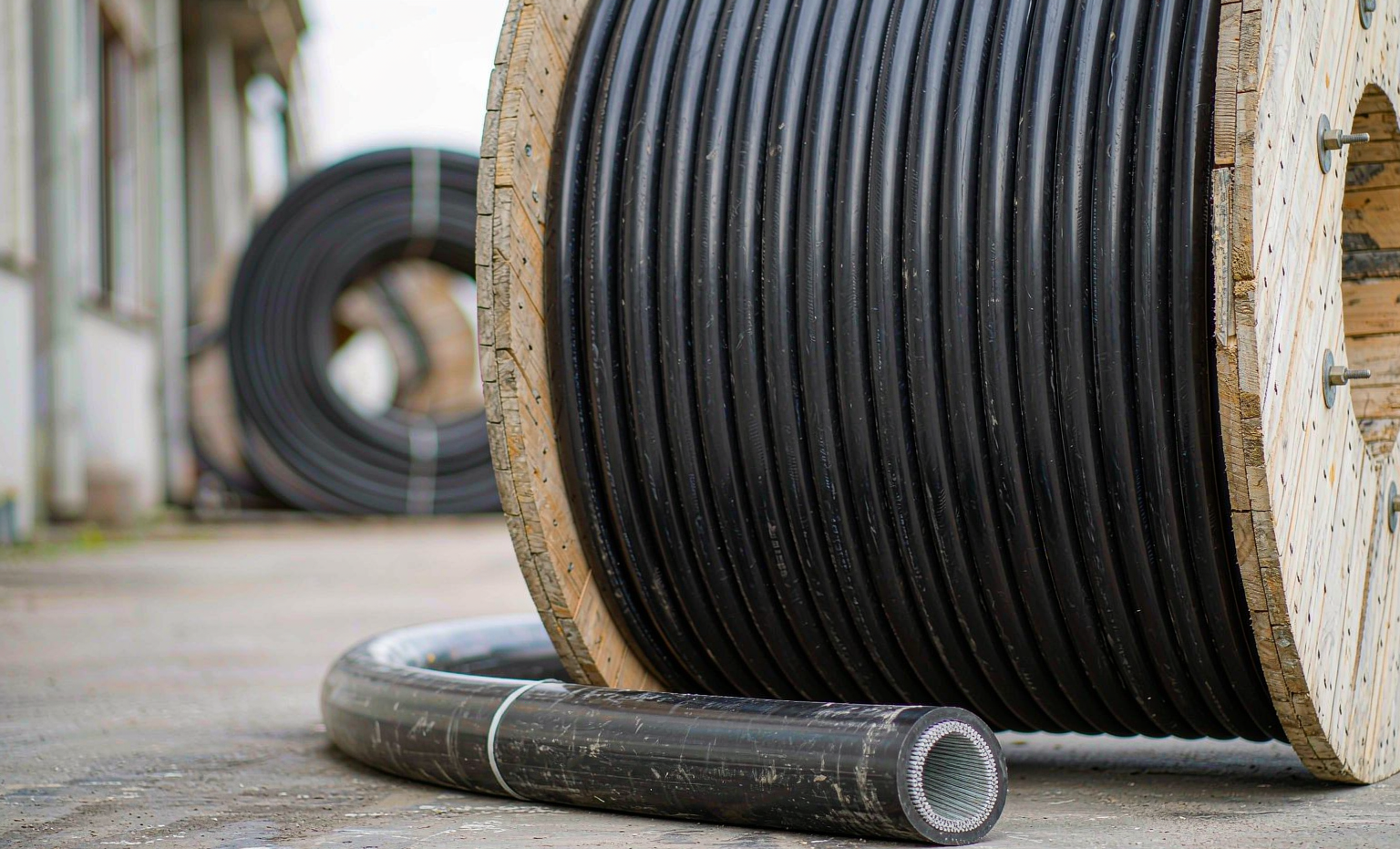
1. What SWA Cable Is, in One Line
SWA = Steel Wire Armour. A power cable with a concentric layer of galvanised steel wires laid between the bedding and the outer sheath, normally over XLPE insulation with a PVC or LSZH outer sheath.
Our standard offering is AL/XLPE/PVC/SWA/PVC 0.6/1 kV multi-core armoured cable — copper (CU) or aluminium (AL) conductor, rated 0.6/1 (1.2) kV, manufactured to IEC 60502-1 and GB/T 12706.
Three things define it:
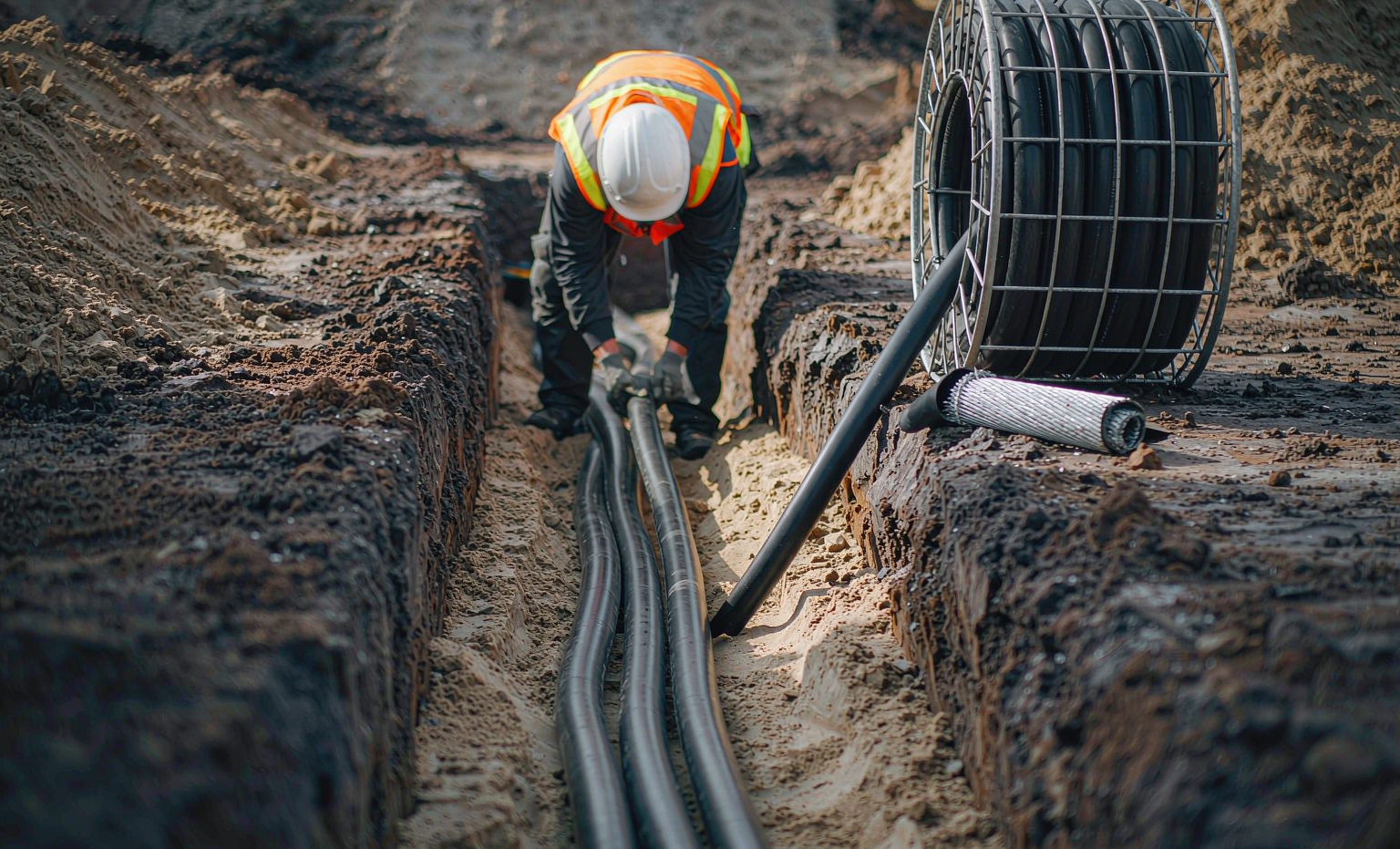
- It can be buried. No conduit required. It runs in wet, outdoor and direct-buried conditions for decades.
- It resists impact. Backfill stones, vehicle loading, and site collisions are stopped by the armour before they reach the insulation.
- It carries tensile load. Steel wire armour takes axial tension, which is what allows vertical shaft runs, long duct pulls and subsea-adjacent installations without a separate support messenger.
2. Decoding the Designation
Chinese type codes and IEC/British designations describe the same cable in two languages. The table below is the translation layer you need when a quotation and a specification have to be compared:
| Chinese code | IEC / BS designation | Armour type | Load capability | Typical use |
|---|---|---|---|---|
| YJV | CU/XLPE/PVC | Unarmoured | — | Tray, conduit, indoors |
| YJV22 | CU/XLPE/PVC/STA/PVC | Double steel tape | Crush resistance, no tensile | Direct burial, ducts, trenches |
| YJV32 | CU/XLPE/PVC/SWA/PVC | Fine steel wire | Crush + tensile | Direct burial, shafts, subsea |
| YJV42 | CU/XLPE/PVC/SWA/PVC (heavy) | Heavy steel wire | Crush + high tensile | Deep vertical shafts, long pulls |
| YJV23 / YJV33 | —/STA or SWA/PE | Steel tape or wire + PE sheath | As above, better weathering | Wet soil, long outdoor exposure |
| YJLV22 / YJLV32 | AL/XLPE/PVC/STA or SWA/PVC | Aluminium conductor + armour | As above | Cost-driven distribution mains |
| WDZ-YJY23 | LSZH version | Low-smoke zero-halogen sheath + armour | As above | Metro, tunnel, data centre |
The one rule worth memorising: the digit in the Chinese code tells you the armour — 2 = double steel tape, 3 = fine steel wire, 4 = heavy steel wire. An “L” after YJ means aluminium conductor (YJLV); a trailing “Y” means a PE outer sheath.
A trap for first-time buyers: single-core AC cables must not use steel armour. In a single-core AC circuit, steel armour experiences eddy currents and hysteresis losses — the armour heats up and the current rating drops. Single-core armoured cable therefore uses aluminium wire armour (AWA). That is exactly why the single-core tables in our 0.6/1 kV data sheet specify AWA, while the two- to five-core tables specify SWA.
3. Construction: What Each Layer Does
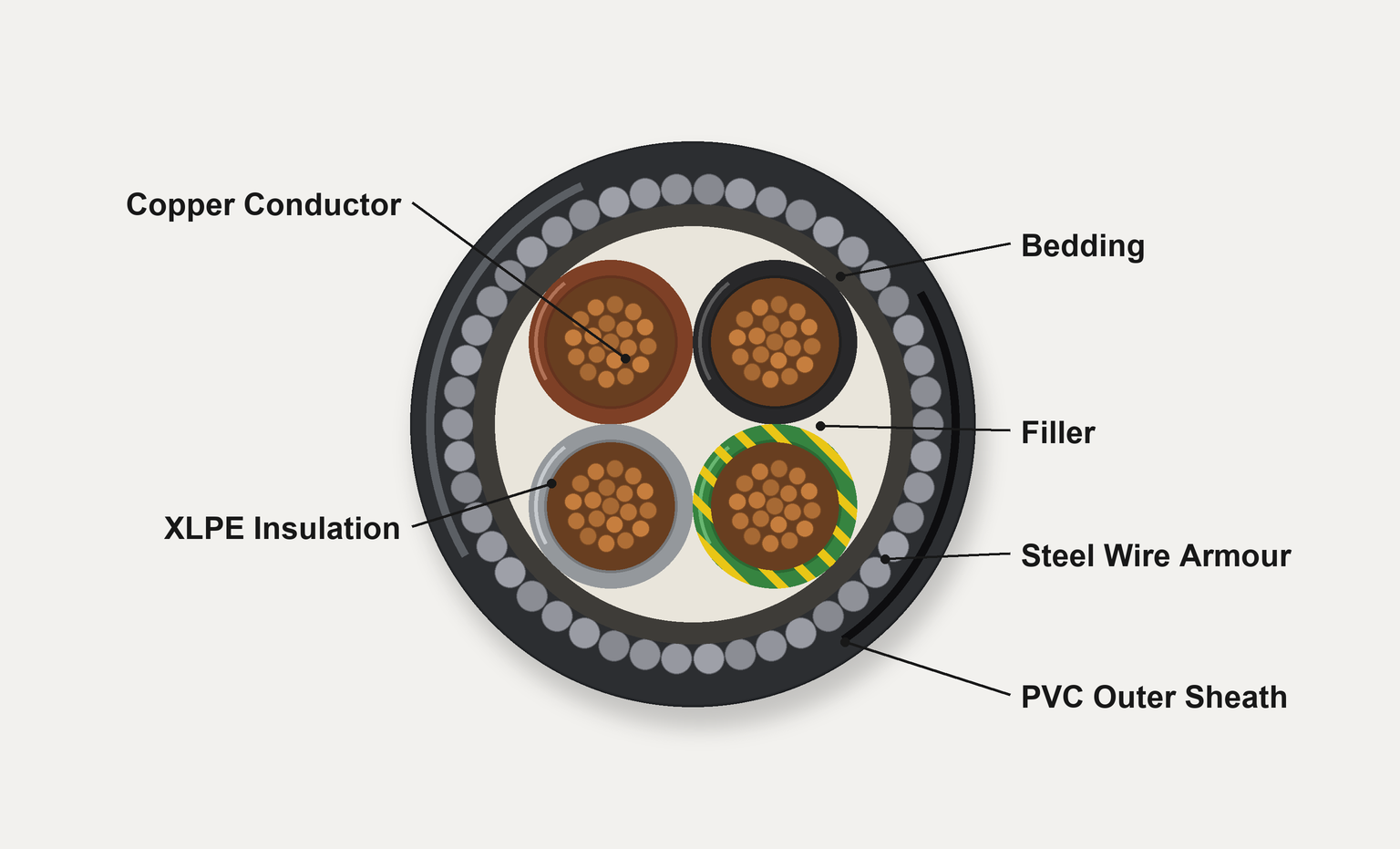
From the conductor outwards, a compliant multi-core SWA cable has seven functional layers:
| # | Layer | Material | Function |
|---|---|---|---|
| 1 | Conductor | Copper or aluminium, stranded Class 2 per GB/T 3956 | Current carrying; stranding gives winding flexibility |
| 2 | Insulation | Cross-linked polyethylene (XLPE) | The dielectric body; 90 °C continuous conductor temperature |
| 3 | Filler | Non-hygroscopic filler | Keeps the laid-up core circular so armour cannot crush the insulation |
| 4 | Bedding (inner covering) | Extruded PVC or applied tape | Critical layer: separates armour from insulation and prevents armour wires from indenting it |
| 5 | Armour | Galvanised steel wire (SWA) or steel tape (STA) | Mechanical protection — crush, tensile, rodent resistance; may also serve as an earth path |
| 6 | Outer sheath | PVC (ST2) or LSZH | Moisture and corrosion barrier; protects the armour from rusting |
Why the bedding layer matters. Armour wires are applied under tension. If they sit directly on the insulation, they leave indentations — and under voltage stress those indentations become the starting point of a breakdown. Bedding thickness and material are one of the fastest ways to tell a properly built cable from a discounted one.
4. SWA vs STA vs AWA vs Unarmoured
This is the decision buyers ask about most. There is no universally “better” option — only fitness for the installation:
| Steel tape (STA / DSTA) | Steel wire (SWA) | Aluminium wire (AWA) | Unarmoured | |
|---|---|---|---|---|
| Radial crush resistance | High | High | Medium | None |
| Axial tensile strength | Very low | High | High | None |
| Suitable for single-core AC | No | No | Yes | Yes |
| Flexibility | Stiff | Stiff | Stiffer than unarmoured | Flexible |
| Rodent resistance | Good | Very good | Moderate (aluminium is soft) | Poor |
| Relative cost | Lower | Higher | Medium | Lowest |
| Typical use | Direct burial, trenches, ducts | Direct burial, shafts, subsea, long pulls | Single-core large sizes, exposed tray | Indoor tray, inside enclosures |
Decision shortcut:
- Needs to take tensile load (vertical shaft, long duct pull, subsea) → specify SWA.
- Only needs protection against backfill and vehicle loading, budget-sensitive → STA is sufficient.
- Single-core AC, large cross-section → AWA.
- Indoor tray with mechanical protection along the whole route → unarmoured is enough.
5. Standards Map Across Markets
The same cable is specified under different standards in different markets. Get this right and customs clearance and tender compliance stop being a problem:
| Market | Standard | Common name | Notes |
|---|---|---|---|
| International | IEC 60502-1 | CU/XLPE/PVC/SWA/PVC | The general framework for 0.6/1 kV extruded-insulation power cable |
| China | GB/T 12706.1 | YJV22 / YJV32 / YJV42 | Technically aligned with IEC 60502-1 |
| UK / Middle East | BS 5467 | “SWA cable” | 600/1000 V thermosetting-insulated armoured cable — the UK default |
| UK (low smoke) | BS 6724 | LSZH SWA | Specified for metro, tunnel and public buildings |
| Australia / NZ | AS/NZS 5000.1 | XLPE/SWA/PVC | Consistent with the IEC family |
| North America | No SWA equivalent | Interlocked MC / AC cable, rigid conduit | “SWA” is not used in North American terminology — describe it as “IEC type, SWA” |
For North American and Canadian buyers: instead of a type code, send a plain specification — “4C × 95 mm², 0.6/1 kV, XLPE insulated, PVC bedded, steel wire armoured, PVC sheathed, to IEC 60502-1”. It removes all ambiguity about what “armoured” means on our side of the order.
6. Real Dimensions and Weights (for Freight and Tray Sizing)
For many buyers the electrical data is already settled and the real questions are outer diameter and mass per kilometre — these drive freight cost, drum size and cable tray selection. The tables below are taken from our copper-conductor XLPE/PVC/SWA/PVC multi-core data sheet to IEC 60502-1.
4-core (4C) typical range
| Size | Armour wire dia. (mm) | Outer sheath (mm) | Approx. OD (mm) | Approx. weight (kg/km) |
|---|---|---|---|---|
| 4C10 | 1.8 | 1.8 | 22.5 | 1059 |
| 4C16 | 1.8 | 1.8 | 25.7 | 1514 |
| 4C25 | 1.8 | 1.8 | 29.3 | 2046 |
| 4C35 | 1.9 | 1.9 | 32.2 | 2545 |
| 4C50 | 2.0 | 2.0 | 35.8 | 3181 |
| 4C70 | 2.2 | 2.2 | 42.4 | 4594 |
| 4C95 | 2.3 | 2.3 | 47.4 | 5875 |
| 4C120 | 2.5 | 2.5 | 52.2 | 7523 |
| 4C150 | 2.6 | 2.6 | 58.0 | 9055 |
| 4C185 | 2.8 | 2.8 | 63.3 | 10811 |
| 4C240 | 3.0 | 3.0 | 69.2 | 13502 |
| 4C300 | 3.2 | 3.2 | 76.4 | 16386 |
3-core (3C) typical range
| Size | Armour wire dia. (mm) | Outer sheath (mm) | Approx. OD (mm) | Approx. weight (kg/km) |
|---|---|---|---|---|
| 3C50 | 1.9 | 1.9 | 32.9 | 2594 |
| 3C120 | 2.3 | 2.3 | 46.3 | 5640 |
| 3C240 | 2.8 | 2.8 | 63.1 | 10766 |
| 3C300 | 3.0 | 3.0 | 69.5 | 13049 |
Standard range: 2C / 3C / 4C / 5C from 10 to 400 mm², plus 2C+E / 3C+E / 4C+E from 16 to 400 mm² (E = earth core). Larger sizes and single-core AWA constructions are available to project order.
Electrical and temperature data (0.6/1 kV range):
- Rated voltage: 0.6/1 (1.2) kV; high voltage test 3.5 kV / 5 min
- Continuous conductor temperature: −15 °C to 90 °C
- Emergency conductor temperature: 105 °C
- Short-circuit temperature (5 s): 250 °C
- Minimum laying temperature: 0 °C
7. Where SWA Cable Is Used
| Application | Why armour is required | Typical sizes |
|---|---|---|
| Direct-buried distribution mains (industrial parks, plants, residential estates) | No conduit; protection against backfill and later excavation | 4C25 – 4C240 |
| Outdoor lighting and landscape circuits | Buried, wet, unattended | 3C16 – 4C50 |
| Vertical shafts and high-rise risers | Must carry its own weight in tension | 4C35 – 4C185, SWA |
| Tunnels and utility corridors | Damp, impact risk, often LSZH-mandated | WDZ-YJY23 type |
| Solar and energy storage plants | Exposed outdoor routing, wide temperature swings, rodent risk | 3C / 4C armoured |
| EV charging and car parks | Buried plus vehicle loading | 3C / 4C armoured |
| Ports, mining and heavy industry | Severe mechanical abuse, oil and dust | 4C120 and above |
| Mobile equipment supply (pumps, fans) | Dragging and wet conditions | Armoured with flexible conductor construction |
8. Five-Step Selection Method (Confirm Each Before Ordering)
Step 1 — Calculate the current rating, not just the cross-section. Apply correction factors per IEC 60287 / IEC 60502 for ambient temperature, soil thermal resistivity, installation method (buried / tray / duct), number of adjacent circuits and burial depth. The difference between direct-buried and clipped-direct current ratings can exceed 30%. We can supply rating tables for your specific installation conditions on request.
Step 2 — Fix voltage level and core configuration. 0.6/1 kV covers the large majority of LV distribution. Specify 3.6/6 kV and above explicitly if required. Three cores for three-phase loads, four cores (3+E) where a protective earth core is needed, five cores (3+2) for three-phase plus neutral plus earth.
Step 3 — Choose the armour form. Use the comparison table in section 4: tensile duty → SWA, crush duty only → STA, single-core AC → AWA.
Step 4 — Choose the outer sheath material. PVC handles most installations. For metro, tunnels, public buildings and data centres, specify LSZH — low smoke density and no halogen acid gas, which is a hard requirement at fire inspection.
Step 5 — Lock down this specification checklist
- [ ] Conductor material (copper / aluminium) and class (Class 2 stranded)
- [ ] Number of cores and nominal cross-sections, including the earth core
- [ ] Rated voltage (e.g. 0.6/1 kV)
- [ ] Insulation material (XLPE)
- [ ] Armour type and material (galvanised steel wire / steel tape / aluminium wire)
- [ ] Outer sheath material (PVC ST2 / LSZH) and colour coding
- [ ] Standard to be applied (IEC 60502-1 / BS 5467 / GB/T 12706.1)
- [ ] Installation method (buried / tray / shaft / duct) and burial depth
- [ ] Minimum bending radius (per manufacturer data sheet — for armoured cable typically more than ten times the outer diameter)
- [ ] Lengths and delivery format (drum size, maximum single length, joint positions)
- [ ] Marking requirements (metre marking, print content, printing language)
- [ ] Third-party inspection and acceptance documents (type test report, routine test report, third-party inspection)
Send this list to a supplier and you will remove three to five rounds of clarification from the quotation process.
9. Five Common Misconceptions
Misconception 1 — Armour works as a screen. It does not. Armour is mechanical protection against crush and tension. A screen (copper tape or braid) is an electromagnetic measure for interference suppression and field grading. If you need interference control, add a screen over the insulation — armour does not replace it.
Misconception 2 — The armour can always be used as the earth conductor. Only under conditions. On a multi-core cable, the steel wire armour — reliably earthed through a brass gland — may serve as the protective conductor provided its conductance meets the fault-current requirement. On large cross-sections and long runs, the armour’s own resistance may be insufficient to carry the fault current, in which case a separate PE core is mandatory. Verify against the local installation code.
Misconception 3 — Single-core cable can use steel armour too. It cannot. In a single-core AC circuit, steel armour produces eddy currents and hysteresis loss, causing heating and derating. Specify AWA (aluminium wire armour) or another non-magnetic armour instead.
Misconception 4 — A bigger cross-section is always safer. Oversizing wastes copper and increases outer diameter and armour wire size, which shortens drum lengths, creates more joints and makes bending harder on site. Select on the corrected design current with a sensible margin.
Misconception 5 — Aluminium conductor is always the cheaper choice. Aluminium costs less per kilogram, but to carry the same current you move up one or two cross-section steps — so diameter and weight rise, and freight plus tray costs can consume the conductor saving. Aluminium also needs bimetallic transition joints; a direct copper-to-aluminium connection will suffer galvanic corrosion. For small cross-sections and short runs, copper is usually the simpler answer.
10. FAQ
Q1 — Can SWA cable be buried directly? How deep? Yes — direct burial is one of its main applications. Standard practice is a sand bed and sand cover with a protective tile or warning tape above the cable. Burial depth is commonly around 0.7 m, increased under roads and load-bearing areas with additional protection. Follow the installation code applicable to your project location.
Q2 — How much more does SWA cost than STA? At the same size, steel wire armour costs more in material and process time, so SWA is typically slightly more expensive than STA. The gap depends on cross-section and wire diameter. If the installation only needs crush protection against backfill, STA is the more economical specification.
Q3 — Can I order small quantities, like 10 or 20 metres? Yes. Our minimum order quantity on armoured cable is 1 metre, and we supply samples and trial quantities.
Q4 — Do you make armoured cable with an LSZH outer sheath? Yes — the WDZ-YJY23 construction (low-smoke zero-halogen sheath over armour), commonly specified for metro, tunnel, data centre and public building projects.
Q5 — Can you supply flame-retardant (ZC) or fire-resistant (NH) armoured cable? Yes. Flame-retardant types such as ZC-YJV22 and fire-resistant types such as NH-YJV22 can both be built on an armoured construction. Please state the flame-retardant grade and fire test standard (e.g. GB/T 19666, BS 6387) when ordering.
Q6 — Is recycled copper used? No. Conductors are made from prime electrolytic copper (or electrolytic aluminium). Material certificates and third-party test reports are available on request.
Q7 — What is the lead time? Common sizes are held in stock. Large cross-sections and special constructions (LSZH, fire-resistant, custom sheath colours) are scheduled to order — send us the list and we will confirm a firm delivery date.
Q8 — How is the cable inspected before shipment? We can provide the routine test report (conductor resistance, insulation resistance, high voltage test, dimensional check) and the type test report against your acceptance criteria, and we can host third-party inspection at the factory.
11. Why Xijiangyue Cable
| Dimension | Data |
|---|---|
| Industry experience | More than 25 years in cable manufacturing |
| Product range | Nearly 30 series, around 4,000 models, 50,000+ specifications |
| Production and testing plant | 3,000+ units/sets, including a German TROESTER CCV 110 kV triple-extrusion XLPE line, a German SIKORA X-RAY 8000 eccentricity measuring system and a US HIPO partial discharge test system |
| Quality metric | First-pass finished-product inspection rate ≥ 98% |
| Management systems | ISO 9001 / ISO 14001 / ISO 45001 / ISO 50001; National Green Factory |
| Product certifications | CCC, Mining Product Safety Mark, CCS (classification society), TÜV, CE, UL and others |
| Export markets | 20+ countries and regions |
| Reference projects | Shanghai Stadium, Shanghai Metro, Xiaoshan Airport, Hangzhou Olympic Sports Centre, Shanghai International Convention Centre |
Armoured power cable is one of our mainstream product families. We supply 0.6/1 kV multi-core copper and aluminium SWA, STA and AWA constructions as standard, and customise cross-sections, core counts, sheath materials and marking to project requirements.
Request a quotation or a technical review
Send us your parameter list — cores, cross-sections, voltage rating, armour type, sheath material, quantity and destination port — and we will come back within one working day with pricing and lead time. If you would rather describe the installation, our engineers will help with the selection.
Contact:
- WhatsApp / phone: +86 199 4242 4884 — chat on WhatsApp
- Email: info@xijiangyuecable.com
- Product page: AL/XLPE/PVC/SWA/PVC 0.6/1 kV multi-core armoured cable
ANHUI XIJIANGYUE CABLE CO., LTD. 25+ years of cable manufacturing · exporting to 20+ countries · ISO 9001 / 14001 / 45001 / 50001

