


Intro: In fire alarm loops, PA/emergency broadcast lines and fire telephone circuits, the cable type that shows up most often is RVS — a two-core twisted flexible wire. But the letters in front of it matter far more than “RVS” itself: ZR, NH, WDZ and WDZN can make the same 2×1.5 mm² pair cost two or three times more, and behave completely differently in a fire. This guide explains what each prefix actually solves, which test backs it up, and which loop needs which.
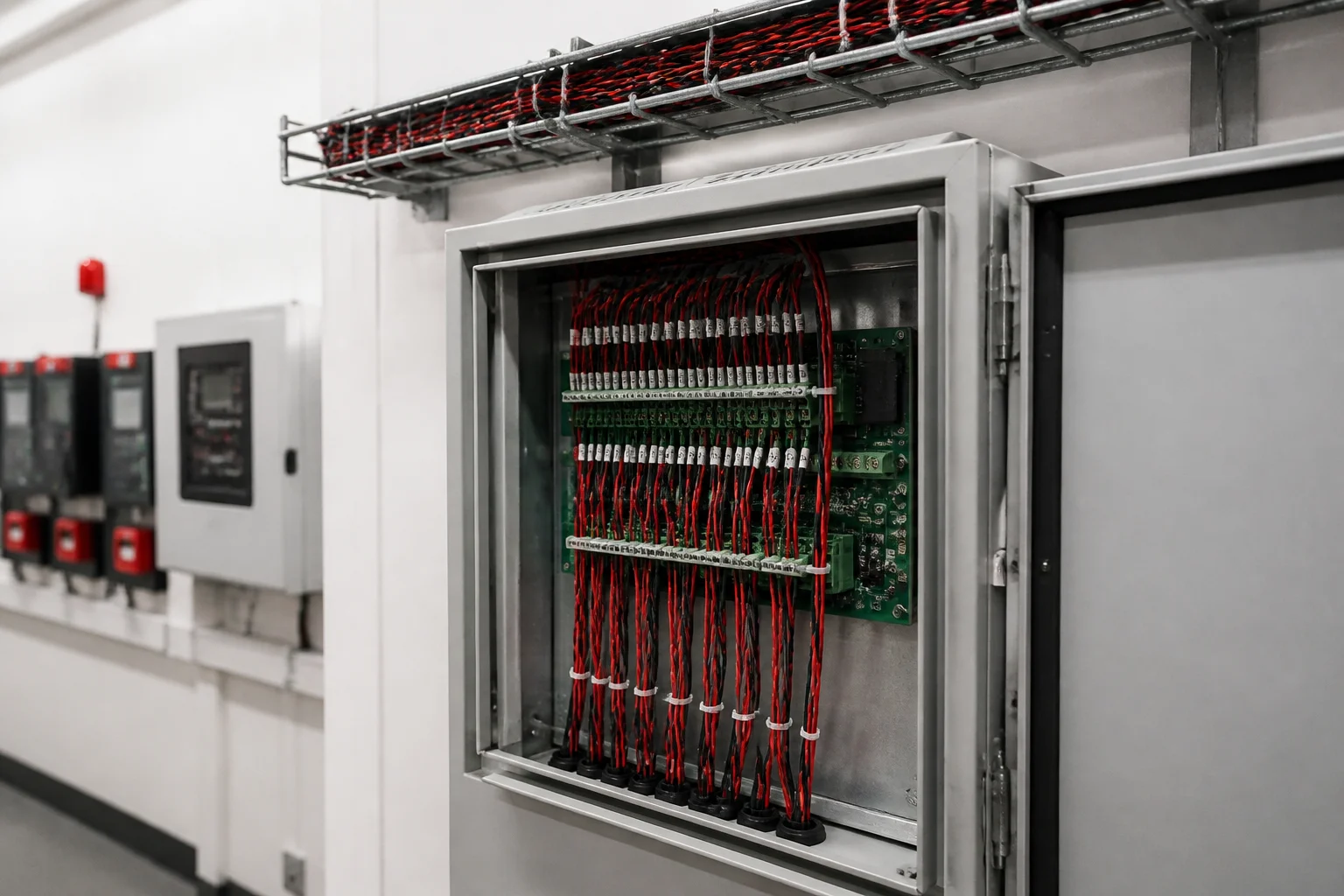
1. Why plain RVS Shouldn’t Go Into a Fire Circuit
A fire tests a cable in three escalating ways:
- Does it help the fire travel along the cable run? — a flame-spread (flame retardant) question.
- Can it still conduct while being burned? — a fire-resistance question.
- Are the smoke and corrosive gases it releases lethal? — a low-smoke, zero-halogen question.
Plain RVS guarantees only basic electrical insulation performance. It promises none of the above. So specifying “RVS” on a fire alarm drawing is not enough — the prefix letters are what decide both the price and the performance.
2. ZR / NH / WDZ / WDZN in One Line Each
| Prefix | Meaning | Problem it solves | Typical construction |
|---|---|---|---|
| ZR | Flame retardant | Self-extinguishes once the ignition source is removed; limits fire travel along the cable run | Flame-retardant PVC insulation |
| NH | Fire resistant | Keeps conducting for a defined period while being burned | Mica tape wrapped over the conductor + PVC insulation (two layers) |
| WDZ | Low smoke, zero halogen, flame retardant | Little smoke and no corrosive halogen acid gas when burning | Halogen-free polyolefin (LSZH / XLPO) insulation |
| WDZN | Low smoke, zero halogen, flame retardant and fire resistant | Both properties at once | Mica tape + halogen-free polyolefin |
The single most important distinction: flame retardant is not fire resistant. ZR means “won’t help the fire spread”. NH means “already on fire and still conducting”. Different tests, different materials, different circuits — they are not interchangeable.
3. “Flame Retardant” Is Not One Grade
Specifying “ZR-RVS” on its own is incomplete. Under GB/T 19666 (the Chinese general rule for flame-retardant and fire-resistant cables), flame-retardant cables are graded ZA / ZB / ZC, corresponding to Classes A, B and C of the bunched (bundle) flame test — IEC 60332-3-22, -23 and -24. The governing difference is the volume of non-metallic material per metre of cable:
| Class | Bunched flame test | Non-metallic material (approx.) | Where it is specified |
|---|---|---|---|
| ZA | IEC 60332-3-22 (Class A) | 7 L/m | High-occupancy, hard-to-evacuate buildings |
| ZB | IEC 60332-3-23 (Class B) | 3.5 L/m | Metro, tunnels, data rooms |
| ZC | IEC 60332-3-24 (Class C) | 1.5 L/m | General commercial and industrial buildings |
There is also a more basic test underneath all of this: single vertical flame propagation, IEC 60332-1-2. Every compliant cable passes it — it is the entry ticket, not a grade. The bunched test is what separates one class from another. So when a supplier says “flame retardant tested”, ask which bunched class and which report.
4. What Holds a Fire-Resistant (NH) Cable Together
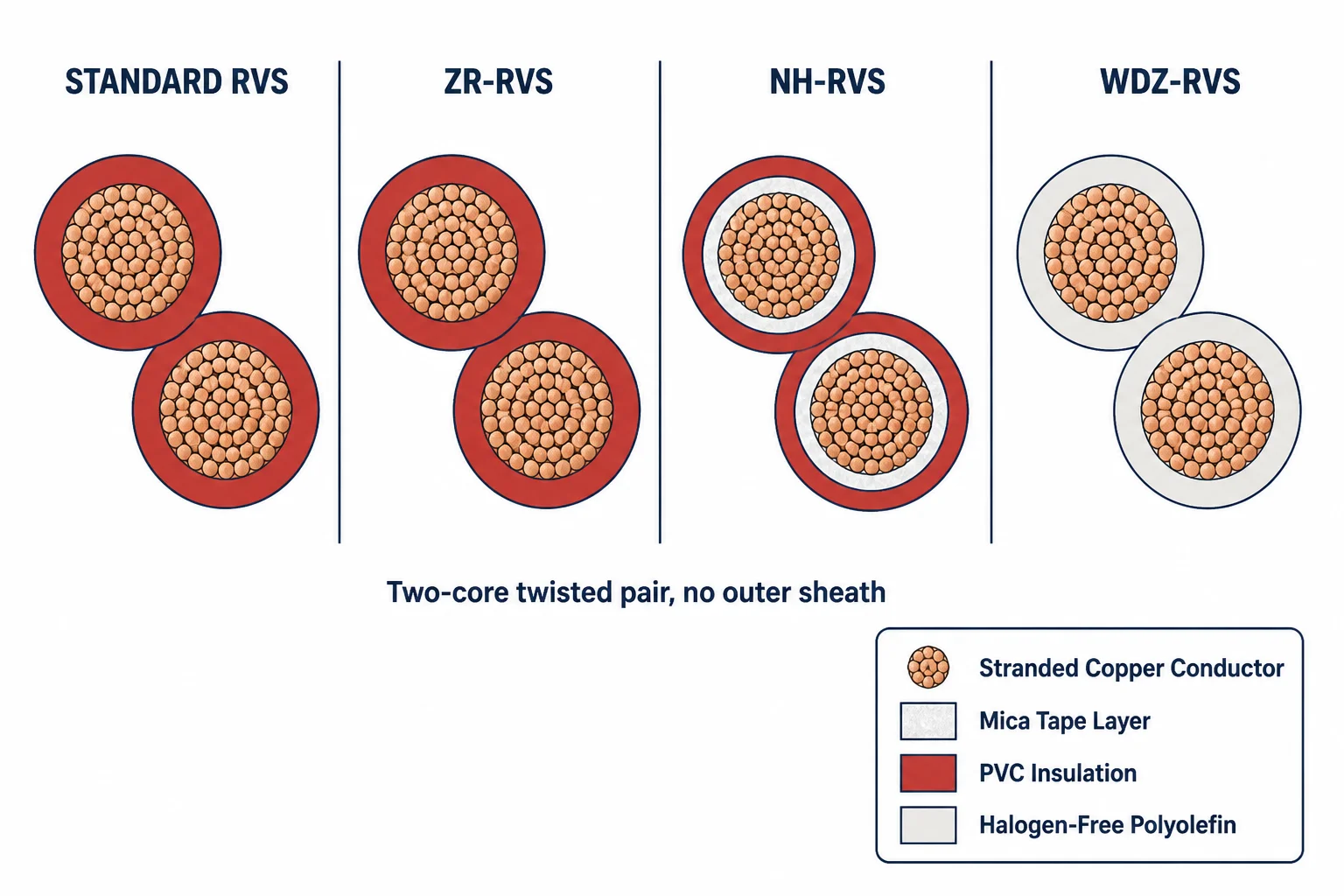
There is really only one decisive element in a fire-resistant RVS: the mica tape.
In production, one or two layers of synthetic mica tape are wrapped helically around the stranded conductor before the PVC insulation is extruded over it. At room temperature the tape is a soft ribbon. Above roughly 700 °C the mica sinters into a ceramic-like shell — still insulating, still heat resistant — which keeps the conductor separated from the flame and holds the circuit alive for a defined window.
The governing tests are IEC 60331-1 and -2 (GB/T 19216 in China):
- IEC 60331-1: 750 °C for 90 min, with the sample subjected to mechanical shock during the burn.
- IEC 60331-2: 750 °C for 90 min, for smaller-diameter cables laid in a normal manner.
- Higher-specification projects may demand 950 °C / 90 min, sometimes combined with water spray and mechanical vibration (the C, W and Z tests of BS 6387, usually written as CWZ).
One point that is easy to miss: the fire-resistance test must be energised. An unloaded test only proves the insulation did not break down. What a project actually cares about is whether the equipment still works while the cable is burning. A supplier’s unloaded fire-resistance report is of limited value.
5. Why Low-Smoke Zero-Halogen (WDZ) Matters in Enclosed Spaces
In a fire, smoke usually incapacitates people before the flame reaches them. PVC insulation releases large volumes of hydrogen chloride and other halogen acid gases, which form corrosive acid when they meet water — irritating to breathe and destructive to electronics, switchgear and structural steel. Low-smoke zero-halogen types exist for exactly these spaces, and two data points decide them:
| Property | Test method | What it tells you |
|---|---|---|
| Smoke density | IEC 61034 (GB/T 17651) | Light transmittance during burning — higher transmittance, less smoke |
| Halogen acid gas | IEC 60754-1 / -2 | -1 measures total halogen acid gas; -2 measures pH and conductivity of the evolved gas |
Metro tunnels, underground car parks, hospitals, data centres, large shopping centres and control rooms with sensitive equipment typically specify WDZ — or WDZN where fire resistance is also required.
6. Which Loop Needs Which Cable
Requirements differ from loop to loop inside the same project. This table maps directly onto a typical fire system design drawing:
| Circuit / use | Recommended type | Why |
|---|---|---|
| Fire alarm loop (detector signal) | ZR-RVS / WDZ-RVS | Twisted pair for noise rejection; priority is stopping fire spread along the loop |
| Emergency / PA broadcast | NH-RVS / WDZN-RVS | Must keep broadcasting during a fire — fire resistance required |
| Fire telephone | NH-RVS | The voice circuit cannot drop out |
| Emergency lighting, exit signs | NH-RVS or NH-BV | Must hold up after mains failure |
| Smoke extraction fan, fire pump control | NH-RVS or NH-KVV | Control signal must survive the fire |
| General ELV, access control, CCTV | Standard RVS | Not a fire circuit — no fire resistance needed |
| Basements, tunnels, data halls | WDZ-RVS | Evacuation and equipment protection first: low smoke, zero halogen |
A workable order of decisions: is it a fire circuit? (decides NH), is the space enclosed or crowded? (decides WDZ), which flame-retardant class? (A/B/C per the design documents and GB/T 19666).
7. Six Things to Check on Delivery
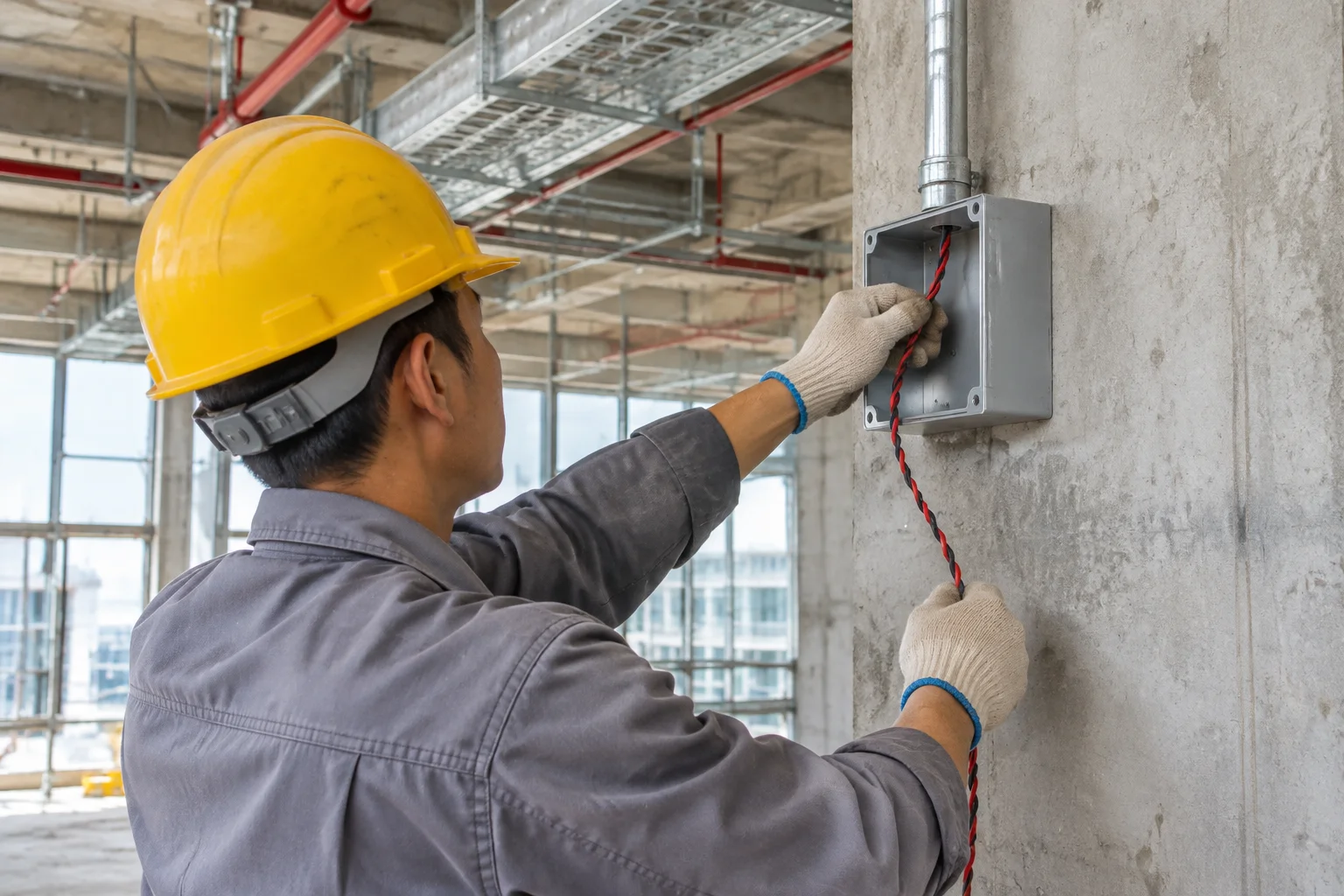
- Complete legend. Type code (e.g. ZR-RVS or NH-RVS), size (2×1.5 mm²), rated voltage 300/300 V, standard number, manufacturer and metre marking. A missing field is a question worth asking.
- Type-test reports, read properly. For flame retardancy the report must state the bunched class (A/B/C). For fire resistance it must state temperature, duration and whether the test was energised. “Passed flame test” is not a specification.
- Can you see the mica tape? Strip an NH-RVS core: there should be a white or pale gold mica tape wrap between the copper and the insulation. No tape, no fire resistance — regardless of the label.
- Wire count and strand diameter. RVS uses a Class 5 flexible conductor. For 2×1.5 mm² the maximum single strand diameter is 0.26 mm and the minimum wire count is 30; for 2×2.5 mm², 0.26 mm and 49 wires (IEC 60228 / GB/T 3956). Markedly fewer wires usually means a non-standard conductor.
- DC resistance at 20 °C. 2×1.5 mm² should be ≤ 13.3 Ω/km and 2×2.5 mm² ≤ 7.98 Ω/km. This is the most direct check on whether the copper is actually there.
- Length and appearance. Confirm the metre marking is honest; the insulation should be smooth, free of voids and eccentricity, and the lay length of the pair should be uniform.
Note: Class 5 flexible conductors are allowed a slightly higher resistance limit than Class 1 solid conductors (13.3 vs 12.1 Ω/km at 1.5 mm²). That is normal, not a defect. But a quoted figure materially above 13.3 means the cross-section has been reduced.
8. Common Mistakes and FAQ
Mistake 1 — the drawing says “RVS” and standard RVS is supplied.<br>On a fire circuit, “RVS” alone is not a specification. It needs at least ZR-RVS or NH-RVS, plus the flame-retardant class.
Mistake 2 — substituting ZR-RVS for NH-RVS.<br>A flame-retardant cable does not assist combustion; it still fails under sustained flame. Broadcast, fire telephone and other circuits that must work during a fire cannot skip fire resistance.
Mistake 3 — relying on a single-cable flame test.<br>IEC 60332-1-2 is the baseline. The ZA/ZB/ZC grades come from the bunched tests in the IEC 60332-3 series.
Mistake 4 — running RVS exposed or direct-buried.<br>RVS has no sheath. It must go in conduit, trunking or on tray. Direct burial and long-term UV exposure both accelerate insulation ageing.
Q1: NH-RVS or WDZN-RVS?<br>Two questions: does the space need low smoke and zero halogen (enclosed, crowded, or full of sensitive equipment — yes), and what is the budget? WDZN gives both properties at a higher price. Above-ground, well-ventilated areas are usually well served by NH-RVS.
Q2: Is 90 minutes of fire resistance enough?<br>The IEC 60331 baseline is 750 °C for 90 min. Whether that is sufficient depends on the building’s evacuation strategy and fire engineering design; high-rise, tunnel and petrochemical installations often specify more (950 °C/90 min or CWZ). The design documents govern.
Q3: Can RVS be used as a power cable?<br>No. RVS is a flexible connecting wire rated 300/300 V, intended for signal and control circuits, not for high-power mains distribution.
Q4: How should the type be written on an export order?<br>RVS sits within the IEC 60227-5 flexible cord family. A workable description is “RVS twisted pair, 300/300 V, JB/T 8734.3, flame retardant” or “fire-resistant twisted pair cable”. Confirm the destination market’s certification requirements (UL / EN / classification society) and state the flame and fire test standards explicitly.
Conclusion
What decides success in fire alarm wiring is not whether RVS was used, but whether the letters in front of it were correct. Flame retardant stops the fire spreading, fire resistant keeps the circuit alive in the flame, and low-smoke zero-halogen keeps the smoke from incapacitating people and destroying equipment. Three different problems, three different answers — none of them substitutes for another.
Match the type to the circuit, match the class to the design, verify against the test report. Do those three and both the acceptance inspection and the worst-case scenario are covered.
If you are sourcing ZR-RVS, NH-RVS or WDZN-RVS fire-rated twisted pair cable and need type-test reports, samples or custom specifications, talk to our team.