


Intro: On ships and offshore platforms, cables face salt spray, oil, vibration, moisture — and the most dangerous factor of all: fire. When a machinery space catches fire, the crew has nowhere to retreat. That is why marine cables are engineered around the worst case, from materials to construction. This guide covers the requirements, construction, product types and classification-society approvals.
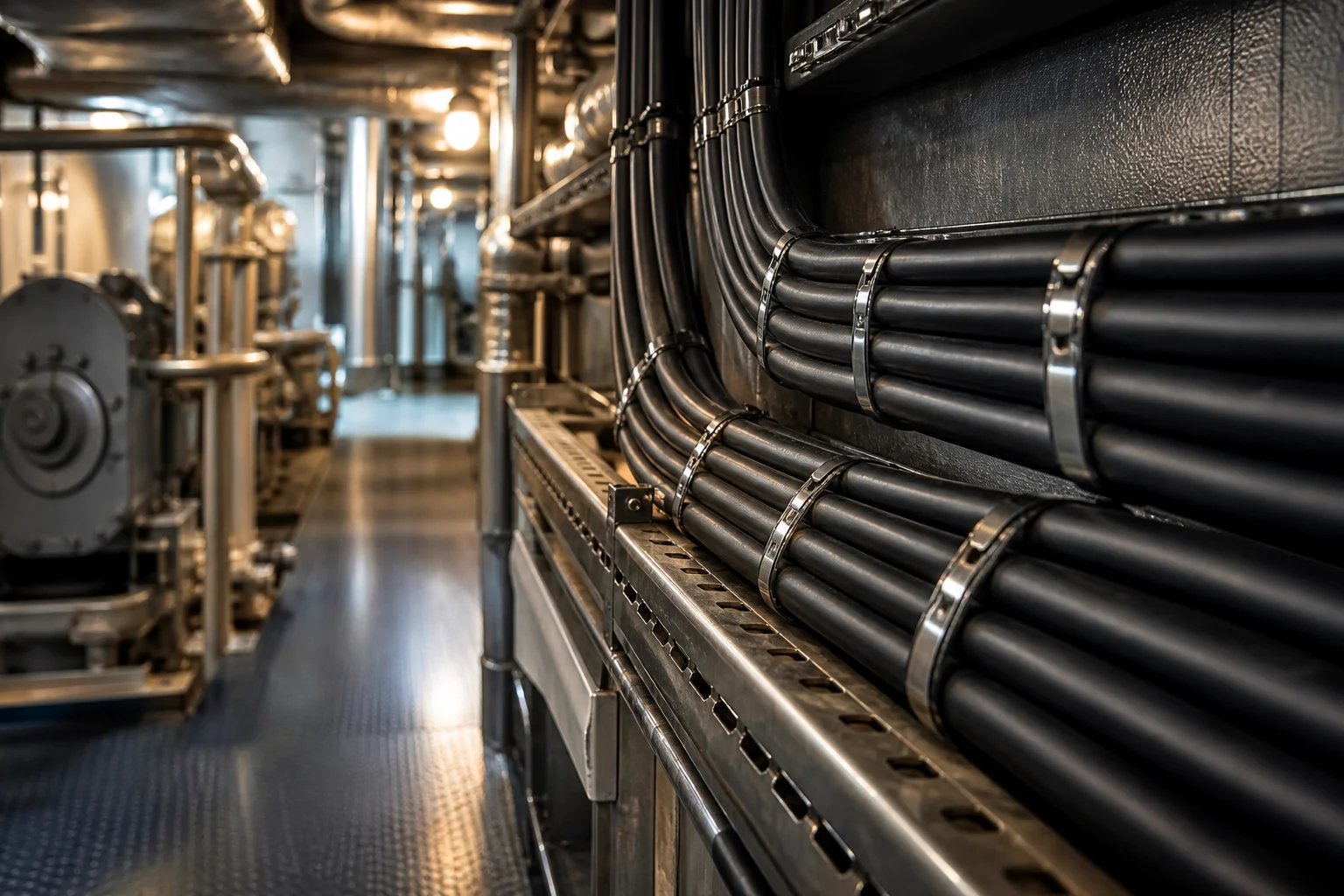
1. What Makes Marine Cable Different?
A building cable assumes people can evacuate and rescuers can arrive. A ship assumes the opposite: enclosed spaces, no outside help, high occupancy.
| Onboard risk | Cable design response |
|---|---|
| Fire in a sealed compartment, no escape | Must be flame retardant (single cable and bunched) |
| Emergency systems must keep running during a fire | Critical circuits use fire-resistant cable |
| Smoke is the main killer at sea | Low smoke zero halogen (LSZH) |
| Oil in machinery spaces, salt spray on deck | Oil, salt-mist and moisture resistance |
| Continuous vibration and mechanical damage | Braided armour, vibration-tolerant construction |
Marine cable is therefore a self-contained standards system plus classification-society type approval — not a thicker version of a land cable.
2. The Tests a Marine Cable Must Pass
| Property | Typical standard | What it means |
|---|---|---|
| Flame propagation (single cable) | IEC 60332-1 | Stops burning when the flame is removed |
| Flame propagation (bunched) | IEC 60332-3 (Cat A/B/C) | Fire does not spread along a cable tray |
| Fire resistance | IEC 60331 | Maintains circuit integrity in a fire (emergency circuits) |
| Halogen-free | IEC 60754-1/2 | No acid gas release — protects people and equipment |
| Low smoke | IEC 61034 | Light transmittance stays usable for evacuation |
| Oil resistance | IEC 60811 series | No swelling or cracking in oily machinery spaces |
| Salt mist / humidity | IEC 60092-350 | Stable long-term performance in marine atmosphere |
Note the difference: flame retardant ≠ fire resistant. Retardant cable stops fire from spreading; fire-resistant cable keeps working inside a fire. Fire pumps, emergency lighting and alarm circuits must use fire-resistant cable.
3. Construction: Every Layer Answers to the Sea
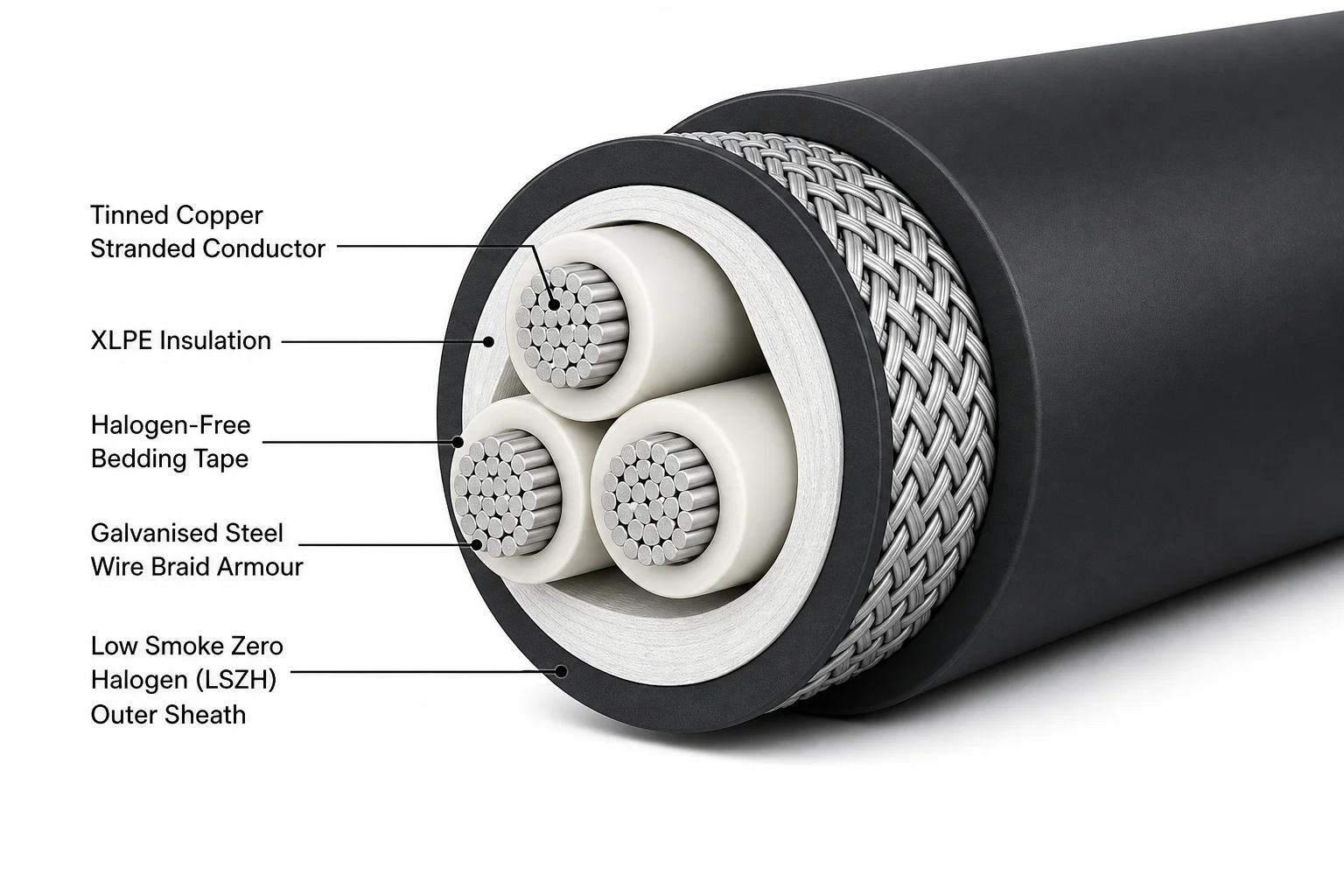
| Layer | Material | Purpose |
|---|---|---|
| Conductor | Tinned copper (stranded) | Tin plating resists oxidation in humid, salty air |
| Insulation | XLPE or EPR | Temperature, oil and dielectric performance |
| Screen | Tinned copper braid (control / instrumentation) | EMI protection and signal integrity |
| Bedding / tape | Halogen-free tape | Separation and mechanical stability |
| Armour | Galvanised steel wire braid or steel tape | Mechanical protection — standard on deck and in machinery spaces |
| Outer sheath | LSZH / oil-resistant compound | Flame retardant, low smoke, halogen-free, oil and salt resistant |
The three fastest giveaways of a marine cable: tinned conductors, halogen-free sheath, and armour. Together they define the product.
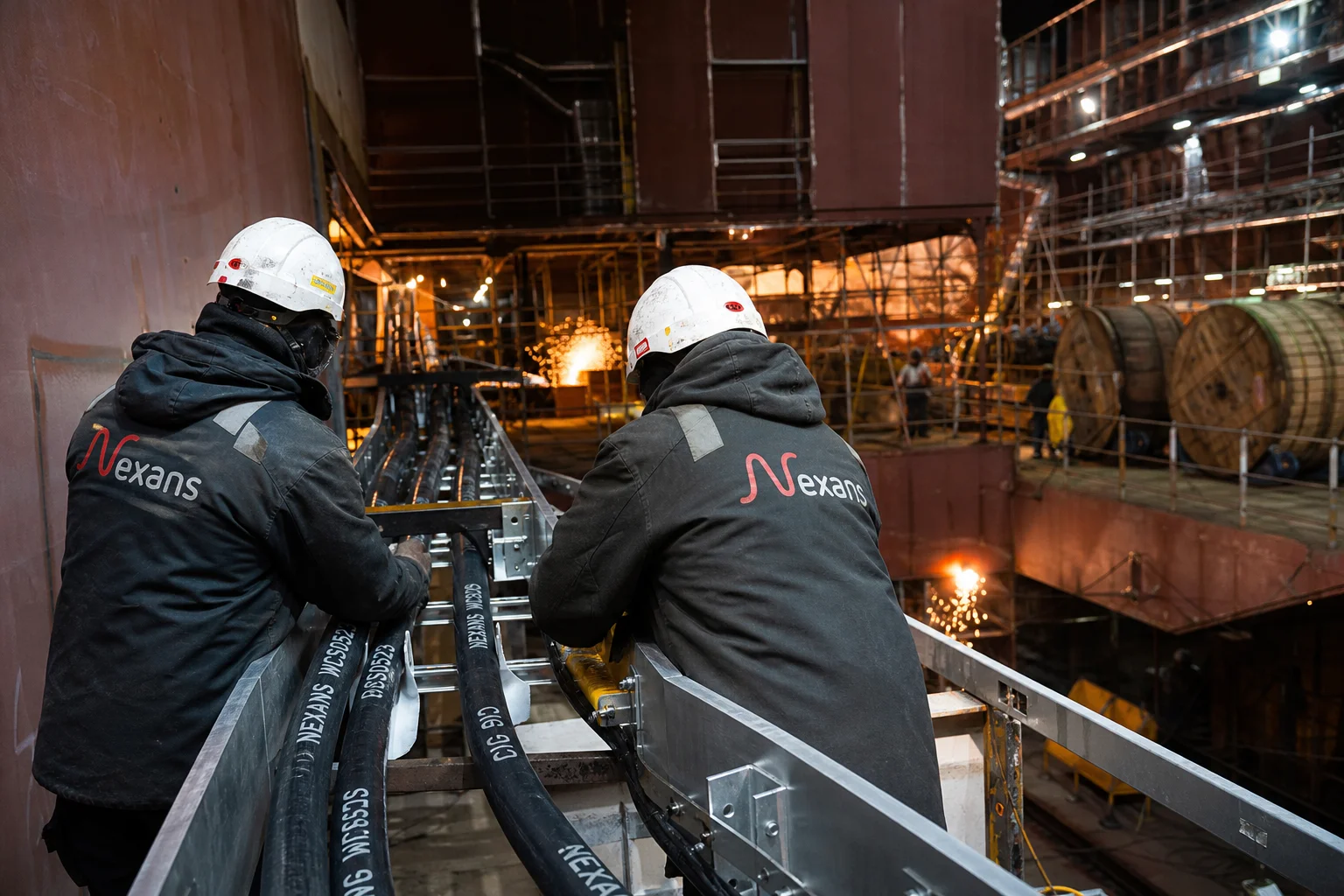
4. Main Product Types
| Type | Typical rating | Where it is used |
|---|---|---|
| Marine power cable | 0.6/1 kV, 3.6/6 kV, etc. | Main switchboard, propulsion and power distribution |
| Marine control cable | 150/250 V | Control and signalling circuits |
| Instrumentation / communication | Low voltage, multicore screened | Sensors, comms and navigation equipment |
| Fire-resistant cable | Per emergency circuit spec | Fire pumps, emergency lighting, alarm systems |
| Offshore / platform cable | NEK 606 and similar | Platforms, drilling units, shore power |
Selection order: define the circuit type (power / control / emergency) first, then voltage class and fire rating, and only then cross-section and armour.
5. Standards and Approvals: The Real Entry Ticket
| System | Key standards | Main markets |
|---|---|---|
| International (IEC) | IEC 60092 series (350 / 353 / 375 / 376) | Global; the base reference for class societies |
| North America | IEEE 1580 / UL 1309 | US and Canadian yards, offshore |
| Offshore (Nordic) | NEK 606 | Norway and offshore platform projects |
Classification-society type approval is the actual gate. Major societies include CCS (China), DNV (Norway), ABS (US), LR (UK), BV (France), NK (Japan), KR (Korea) and RINA (Italy). Without approval from the relevant society, a cable generally cannot be used on a classed vessel.
When buying, verify that the product type, standard number, certificate number and validity period all match.
6. A Five-Step Selection Method
- Classify the circuit: power / control / instrumentation / emergency (emergency circuits must be fire resistant)
- Set the voltage class: 0.6/1 kV covers most installations; MV systems follow the actual busbar voltage
- Set the fire rating: bunched installations must meet the relevant IEC 60332-3 category
- Choose sheath and armour: oil-resistant sheath in machinery spaces; armour on deck and where mechanical damage is likely
- Verify class approval: type, standard and certificate must match, and the certificate must be valid
One practical tip: the yard usually dictates the standard system (IEC or IEEE) at the design stage — get the yard’s specification before quoting, and you avoid most rework.
7. Common Mistakes and FAQ
- “Marine cable just means flame-retardant cable.” Flame retardance is only the entry requirement; LSZH, oil resistance, salt resistance and class approval are equally mandatory.
- “An IEC test report is enough to get on board.” An IEC test report is not a class type approval, and neither substitutes for the other.
- “Fire-resistant cable can replace flame-retardant cable anywhere.” Fire-resistant construction is more complex and more expensive; use it only where emergency circuits demand it.
Q: Can marine cable be used on land? Technically yes, but the cost is hard to justify. The reverse is not allowed — land cable cannot go into a classed vessel.
Q: Is tinned conductor really necessary? Yes. In humid, salt-laden air, bare copper oxidises and contact resistance rises, shortening service life.
8. Final Thoughts
Marine cable is expensive not because of the copper, but because of certification, materials and construction. Once you understand that logic, procurement stops being a price comparison and becomes a check of certificates, standards and structure.
Looking for a marine cable supplier for a vessel or offshore project? Contact us for datasheets, class-society certificate lists and samples.