

BVVB Cable Explained: Flat Twin PVC Sheathed Wire — Type Codes, H05VVH2-F Equivalent & Sourcing Guide
Release time: 2026-10-16
Your drawing says “flat twin cable, 2 × 1.5 mm², 300/500 V, PVC insulated, PVC sheathed”. The Chinese quotation comes back as BVVB 2 × 1.5.
They are the same cable. BVVB is simply the Chinese type designation — and once you can read the four letters, you can check any quotation against any specification in seconds instead of guessing.
This guide covers what BVVB flat cable actually is, how each letter maps to a construction layer, what the flat profile really buys you on site, how it differs from BV / BVV / RVVB, whether there is a true European equivalent, and the specification checklist worth locking down before you issue a purchase order. Every core count, cross-section, dimension, current rating and weight below comes from our real flat sheathed cable data sheets.
1. What BVVB Cable Is, in One Line
BVVB = copper conductor, PVC insulated, PVC sheathed flat (parallel) cable for fixed wiring, rated 300/500 V, normally 2 or 3 cores, 1.5–4 mm², with solid Class 1 copper conductor.
Three characteristics define where it belongs:
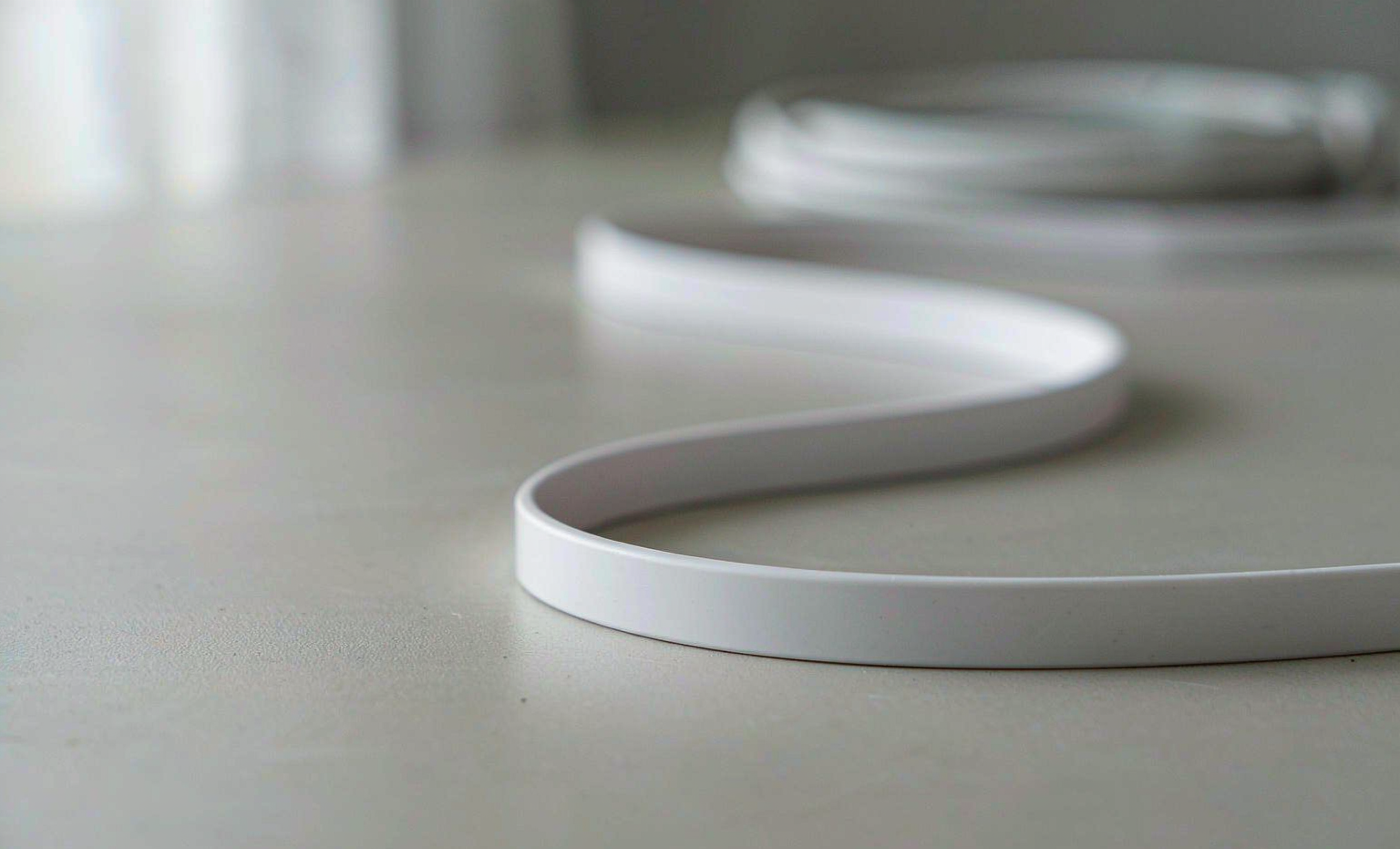
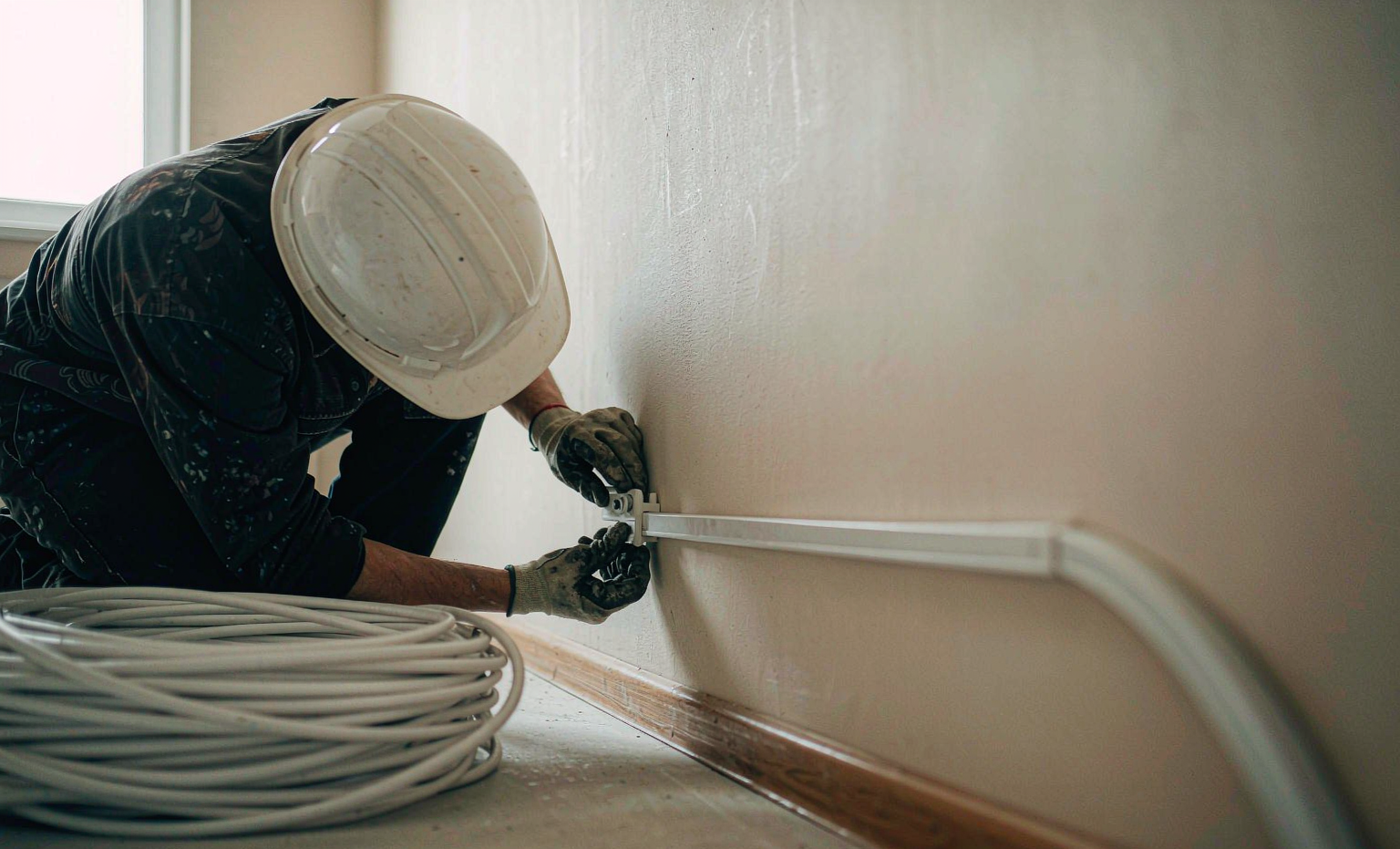
- It is flat. Two (or three) insulated cores are laid parallel, and a single PVC sheath is extruded over the whole row to form a flat rectangular section. This is not a cosmetic choice — it decides how narrow a gap the cable can pass through: door frames, behind skirting boards, under carpet, curtain-wall joints.
- It is a fixed-wiring cable, not a flexible cord. BVVB uses solid Class 1 copper (the same conductor family as BV), so it takes a large bend radius and is not intended for repeated flexing. Where softness or movement is required, specify RVV or RVVB instead.
- It is a 300/500 V domestic and commercial distribution wire. Lighting circuits, socket circuits, panel jumpers. It is not a power cable (YJV), not a control cable (KVV), not a rubber-sheathed cable (YC).
Our flat sheathed cable is manufactured to GB/T 5023-2008, which is equivalent to IEC 60227, and can also be produced to BS 6004 and DIN VDE 0281 requirements. It holds CCC certification.
2. Decoding the Type Code
BVVB has four letters, and every one of them means something specific:
| Letter | Position | Meaning |
|---|---|---|
| B | 1st | Wiring conductor for fixed installation — solid Class 1 copper |
| V | 2nd | PVC insulation |
| V | 3rd | PVC sheath |
| B | 4th | Flat (cores laid parallel) |
In other words: the first B says “solid conductor, fixed wiring”; the last B says “flat”. The two B’s are not the same thing, and that is the single most misread point in the whole designation.
From that structure the whole family follows immediately:
| Type code | Construction | How to read it | Typical use |
|---|---|---|---|
| BV | Copper, PVC insulated single-core wire (unsheathed) | B = fixed wiring, V = PVC insulation | In conduit, panel jumpers |
| BVV | Copper, PVC insulated, PVC sheathed, round | B + V + V | Surface wiring, cable tray |
| BVVB | Flat BVV, 2 or 3 parallel cores | final B = flat | Surface-mounted runs, chased into joints, under carpet |
| RVV | Round flexible sheathed cord | R = flexible (Class 5) conductor | Appliance leads, extension leads |
| RVVB | Flat RVV (flexible conductor) | R + V + V + B | Flat routing where flexibility is also needed |
| RVS | Twisted pair flexible cord | S = twisted | Fire broadcast, intercom, access control |
| BVR | Copper, PVC insulated flexible single-core wire | final R = flexible conductor | In conduit where some flexibility is needed |
Two rules worth memorising:
- The first letter decides the conductor. B means solid (Class 1, stiff); R means stranded soft copper (Class 5, flexible). Same cross-section, same insulation and sheath — the stiffness decides whether the cable may be bent repeatedly or moved at all.
- A final B only means “flat”. BVVB and BVV have identical electrical performance, voltage class and insulation thickness system. The only difference is section shape: round versus flat.
The mistake overseas buyers make most often: reading `BVVB` and assuming the European flat-cord equivalent applies. It may — but only if cross-section range, temperature class and certification system all line up. Similar letters are not proof of interchangeability.
3. Construction: What Each Layer Does
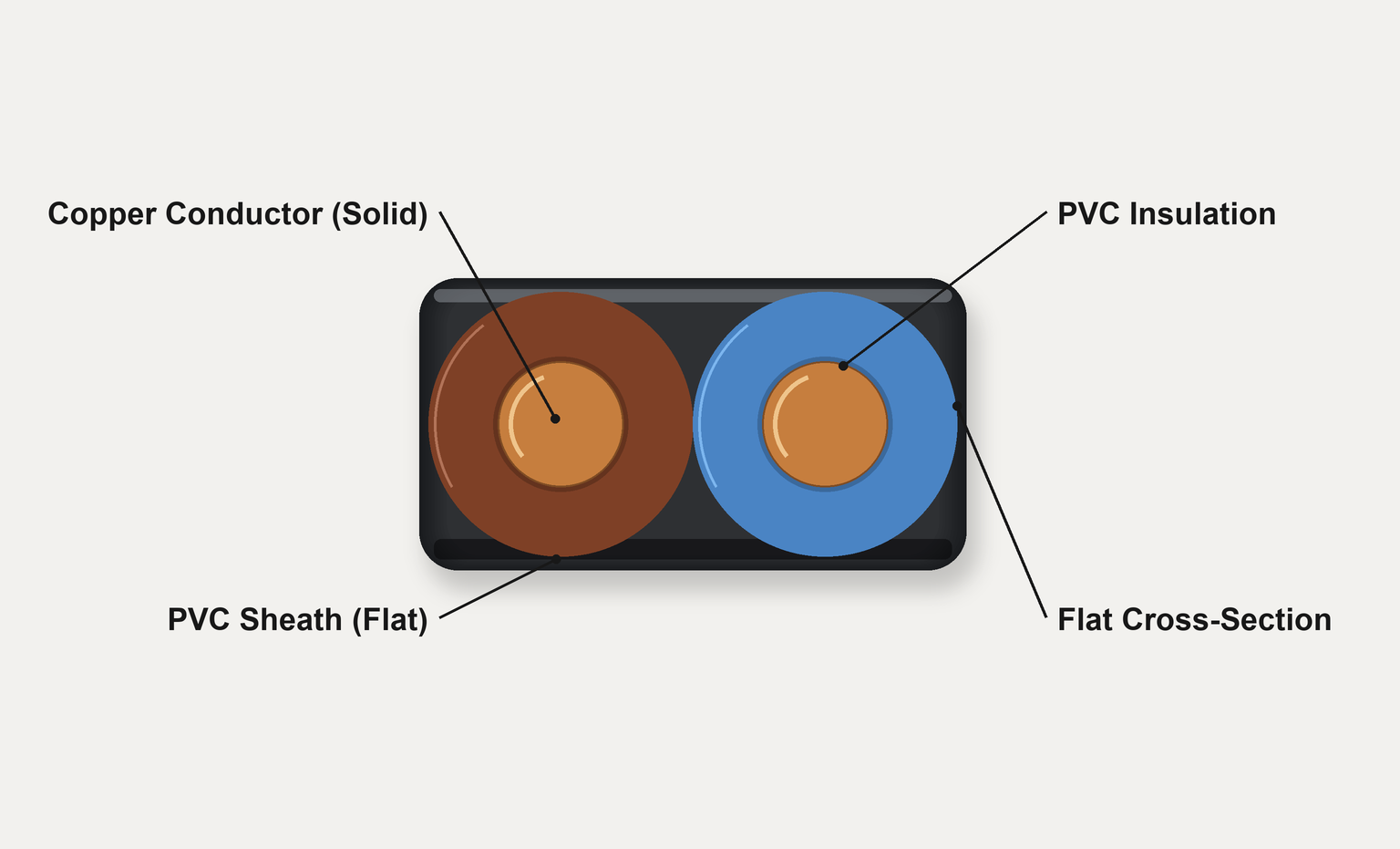
A standard BVVB has three material layers plus one shape feature:
| # | Layer | Material | Function |
|---|---|---|---|
| 1 | Conductor | Solid copper (Class 1, GB/T 3956) | Carries current; the solid construction holds its shape when fixed to a wall or in a trunking |
| 2 | Insulation | PVC | Core-to-core dielectric barrier; nominal thickness 0.7–1.0 mm depending on cross-section |
| 3 | Sheath | PVC, extruded flat over the row of cores | Moisture and mechanical protection; carries the surface marking (type, voltage, cross-section, standard) |
| — | Shape feature | Cores laid parallel, joined by the sheath material forming a web | Holds a constant core spacing and produces the flat profile that allows surface and gap routing |
Why the flat profile has real engineering value. A round cable laid against a wall always leaves an arc-shaped void behind it, so it never actually sits flat and a clip cannot compress it properly. A flat cable sits plane against the surface: one clip flattens it, the finish looks neat, dust does not collect behind it and nothing snags on it. In gap routing — inside a door frame, between skirting board and wall, between carpet and skirting — the diameter of a round cable is a hard threshold it either clears or does not. Flattening the same cross-section dramatically reduces the height that must pass through. The flat profile is not an aesthetic choice; it is the answer to a space constraint.
4. The BVVB Family: Cables That Look Alike
| Type | Conductor | Shape | Voltage | Movable | Main application |
|---|---|---|---|---|---|
| BV | Solid (Class 1) | Round, single core | 450/750 V | Poor | In conduit, panel jumpers |
| BVV | Solid (Class 1) | Round | 300/500 V | Poor | Surface wiring, tray, fixed wiring |
| BVVB | Solid (Class 1) | Flat, 2/3 cores | 300/500 V | Poor | Surface runs, gap routing, under carpet |
| RVVB | Stranded (Class 5) | Flat | 300/500 V | Good | Flat routing where flexibility is needed |
| RVV | Stranded (Class 5) | Round | 300/500 V | Good | Appliance leads, extension leads |
| BVR | Stranded (Class 5) | Round, single core | 450/750 V | Fair | In conduit, where some flexibility helps |
| YC / YZ | Stranded | Round, rubber sheath | 450/750 V | Excellent | Site work, outdoor, oily environments |
In one line: fixed and needs to sit flat or pass through a gap → BVVB; fixed and round is fine → BVV; needs to be both flexible and flat → RVVB; needs to be flexible and shape does not matter → RVV; outdoor or oily → rubber-sheathed YC.
5. Standards Mapping: Is There a True European Equivalent?
This is the question European and US buyers ask most. The answer: there is no exact one-to-one counterpart on the European side — because European flat cords (H05VVH2-F and similar) are almost all flexible-conductor constructions, whereas BVVB is solid conductor.
| Chinese type | Closest European equivalent | Voltage | Conductor | Key difference |
|---|---|---|---|---|
| BVVB (solid, flat) | H05VH2-U (flat, solid, single) | 300/500 V | Solid | European flat solid wire is generally single core; flat twin is usually flexible |
| RVVB (flexible, flat) | H05VVH2-F | 300/500 V | Flexible (Class 5) | The closest flat/oval flexible cord |
| BVV (solid, round) | H05VV-U family (partly round solid) | 300/500 V | Solid | Round section, not flat |
| RVV (flexible, round) | H05VV-F | 300/500 V | Flexible | Round shape |
| BV (solid single core) | H07V-U / H07V-R | 450/750 V | Solid / stranded | Single core unsheathed, higher voltage class |
Three points that matter commercially:
- Conductor class is a hard threshold. H05VVH2-F is a flexible (Class 5) conductor. If your application depends on the rigidity of a solid conductor — for example, a cable chased into a joint that must not sag or deform — you cannot substitute H05VVH2-F for BVVB. Specify “solid conductor, flat” explicitly.
- Check the voltage class item by item. BVVB is 300/500 V, while single-core BV is 450/750 V. If a drawing mixes BV and BVVB, the rated voltages may differ and the quotation should list them separately.
- There is no North American equivalent type. The closest constructions are the SPT family of UL 62 (SPT-1 / SPT-2 / SPT-3 flat cords), but the temperature system (60/75/90 °C rating), conductor class and certification route all differ. UL certification must be carried out separately; “equivalent replacement” cannot be claimed on the strength of the type code.
6. Real Data: Type Matrix and Sizing Data
6.1 Key specifications
| Parameter | Value |
|---|---|
| Standard | GB/T 5023-2008, equivalent to IEC 60227; also producible to BS 6004 and DIN VDE 0281 |
| Rated voltage | 300/500 V |
| Conductor | Solid copper (Class 1) |
| Insulation | PVC |
| Outer sheath | PVC |
| Cores and layout | 2 or 3 cores, laid parallel in a flat formation |
| Operating temperature | −30 °C to +70 °C |
| Short-circuit temperature | +160 °C (max 5 seconds) |
| Fire performance | Flame retardant, to IEC 60332-1 |
| Certification | CCC (CE and others available on request) |
6.2 Model and dimension matrix
| Model | Cores and shape | Conductor size | Sheath thickness | Key application |
|---|---|---|---|---|
| BVVB-2×1.5 | 2 cores (flat) | 1.5 mm² | 0.8 mm | Lighting circuits, switches |
| BVVB-2×2.5 | 2 cores (flat) | 2.5 mm² | 1.0 mm | Power sockets, home appliances |
| BVVB-3×1.5 | 3 cores (flat) | 1.5 mm² | 0.8 mm | Three-phase lighting, control systems |
| BVVB-3×4 | 3 cores (flat) | 4.0 mm² | 1.2 mm | High-load circuits, industrial panels |
Note: the 3-core flat layout is physically three cores side by side in a row, so its outer profile differs from the simple flat twin. When specifying a 3-core, check the width of the installation space, not only the height.
6.3 Detailed specifications (ready for sizing calculations)
| Parameter | BVVB-2×1.5 | BVVB-2×2.5 | BVVB-3×1.5 | BVVB-3×4 |
|---|---|---|---|---|
| Conductor type | Solid copper | Solid copper | Solid copper | Solid copper |
| Insulation thickness mm | 0.7 | 0.8 | 0.7 | 1.0 |
| Overall dimensions mm (thickness × width) | 3.2×6.0 | 3.6×7.2 | 4.5×7.8 | 5.5×10.0 |
| Current rating A | 16 | 25 | 16 (per core) | 32 (per core) |
| Approx. weight kg/km | 40 | 65 | 55 | 120 |
Three usage notes:
- Current rating depends heavily on installation method. The values above are references for a single cable in free air. Buried in a wall, covered by insulation or bunched with other cables, heat dissipation is far worse and derating is mandatory. Ignoring this is a common cause of overheating on site.
- Overall dimensions are the critical data for a flat cable. Confirm both numbers — thickness and width — before ordering. Many gap-routing situations are limited by thickness, while surface runs limited by cable-clip width are limited by width.
- Solid conductor must not be flexed repeatedly. BVVB can be bent to shape once during installation, but it must not be worked back and forth like a flexible cord — solid copper work-hardens and can crack.
7. Where BVVB Cable Is Used
| Application | Why BVVB fits | Typical sizes |
|---|---|---|
| Residential and commercial indoor wiring (concealed chase) | Primary wiring in home and office renovation, embedded in walls or trunking to feed fixtures, sockets and switches | 2×1.5 / 2×2.5 mm² |
| Surface trunking and no-chase renovation | Where opening the wall is not an option, a flat surface run looks neat and stays easy to service | 2×1.5 / 3×1.5 mm² |
| Distribution box and control cabinet wiring | Stable structure holds its shape for neat bundling and fixing inside the enclosure | 2×1.5 / 3×1.5 mm² |
| Commercial display and lighting systems (malls, showrooms, light boxes) | Flexible routing to suit the layout, and a tidy bond to the mounting surface | 2×1.5 / 2×2.5 mm² |
| Fixed-length supply to large appliances such as air conditioners | Fixed run, no movement, and a solid conductor gives a stable termination | 2×2.5 / 3×4 mm² |
| Door frames, skirting joints and under-carpet runs | The flat profile passes through gaps a round cable simply cannot clear | 2×1.5 mm² |
8. Specification Checklist: Five Steps
Step 1 — Fix the core count. Single-phase equipment normally needs 2 cores (line + neutral); where earthing is required, 3 cores — and confirm a matching flat construction exists, since the 3-core arrangement is not simply a wider version of the 2-core. For control circuits, count the signal ways.
Step 2 — Fix the cross-section. Lighting circuits commonly use 1.5 mm², socket circuits and general appliances 2.5 mm², high-load circuits 4 mm². Check it both ways against the current rating and the breaker setting — the conductor must carry the current the breaker will pass before it trips.
Step 3 — Fix the space. This is the step unique to flat cable. Measure the actual gap thickness at the installation point and the width needed for any surface run, then select against the overall dimensions in the table above. Get this wrong and the cable will not fit when it arrives.
Step 4 — Fix temperature and fire requirements. Standard −30 to +70 °C is right for ordinary indoor conditions; routes through hotter areas (ceiling voids near heat sources, plant rooms) need separate confirmation. Flame retardance to IEC 60332-1 is standard; a higher category such as bunched flame retardance to IEC 60332-3 must be specified separately.
Step 5 — Fix the standard and certification. EU export requires the corresponding EN 50525 series type plus CE certification; China requires CCC to GB/T 5023; the US market requires separate UL 62 certification (the SPT family). Confirm all of this before placing the order — retrofitting certification costs lead time.
9. Four Common Misconceptions
Misconception 1: “BVVB is just flat BVV, so they swap freely.” Shape changes the installation method. BVV is round and pulls through conduit easily; BVVB is flat and bonds neatly to a surface, but needs care inside conduit because twisting in the duct affects the pull. They are not unconditionally interchangeable.
Misconception 2: “BVVB and RVVB are both flat, so either will do.” They are not. BVVB is solid conductor and RVVB is stranded. The first wins on rigidity and a flush surface finish; the second wins on bendability and vibration tolerance. Any application that involves movement or vibration must use RVVB.
Misconception 3: “Just read the current rating off the table — the installation method does not matter.” The table is a single-cable-in-air reference. Embedded in a wall, covered by insulation or bunched together, heat dissipation drops sharply and derating is compulsory. This is the step most often skipped when a flat surface run is converted into a concealed one.
Misconception 4: “It is just wire — any length will do.” Long runs must be checked for voltage drop. The smaller the cross-section, the higher the resistance per metre and the more the voltage falls at the far end. Keep lighting circuits within about 3% drop and power circuits within about 5%.
10. FAQ
Q1: Is the BVVB conductor solid or stranded? Solid hard copper (Class 1). That is exactly why it suits fixed installation and should not be flexed repeatedly. For a flexible conductor, choose RVVB.
Q2: How many cores are available? The standard range is 2 and 3 cores. Other core counts or arrangements (for example a symmetrical 3-core flat) can be customised on request.
Q3: Are flame-retardant and fire-resistant versions available? The standard product is already flame retardant to IEC 60332-1. Higher bunched flame retardance, fire resistance (NH) and low smoke zero halogen (WDZ) are derivative characteristics — state them on the order.
Q4: What is the largest cross-section? The standard range goes up to 4 mm². Larger cross-sections normally move to a round sheathed construction (BVV), because a flat profile grows too wide at large sizes and the installation space is usually insufficient.
Q5: Is there a European equivalent type? The closest European flat flexible cord is H05VVH2-F, but it uses a flexible conductor. Where a solid-conductor flat wire is essential, the European side points to a single-core solid flat wire such as H05VH2-U. Confirm against conductor class and actual parameters rather than letters.
Q6: What is the MOQ and lead time? Our product pages list a minimum order of 1 metre, so both sample quantities and full production orders can be handled. Lead time is confirmed against the specific specification and quantity.
11. About Us and Contact
We have manufactured cable for more than 25 years, with close to 30 product series, around 4,000 product types and 50,000+ specifications, supported by 3,000+ production and testing units. Our products are exported to more than 20 countries and regions. The company holds ISO 9001 / 14001 / 45001 / 50001 system certification, manufactures to GB, IEC, BS, DIN and ASTM standards, and carries CCC, CE, TÜV and UL product certification, with a first-pass finished-product inspection rate consistently above 98%.
For a BVVB quotation, data sheet or sample, contact us directly:
- WhatsApp: +86 199 4242 4884
- Email: info@xijiangyuecable.com
- Website: https://www.xjycable.com